How I relic a Stratocaster
What year, what sound, and what the Strat's been through. The questions, where the wear goes, the paint, and why it takes longer.
The first question. What year?
If somebody comes to me wanting a relic'd Strat, the first question is what year. They vary massively, both sonically and in feel. Just the difference between a 7.25 radius fretboard, which is what the originals were, and the 9.5 they became is huge. It's not that people don't know the original Strats had a 7.25 radius neck. It's that people are so used to a Fender being a 9.5 inch radius at a 25.5 inch scale — something like 95 per cent of the electric guitars Fender has made are — that they forget there's a difference. I'm guilty of it too. I often forget. The scale length never changed; the radius did. The original board had a lot more curve to it. If every guitar you've ever played feels like a flat piece of wood, you may be playing a 12 or a 20 inch radius, and then it literally is.
What year ticks a few boxes. If they know exactly what year, they probably also know exactly what sound they're looking for. If they don't, it's: okay, what kind of sound? Who's your go-to Strat player? Which usually gives me the answer. And if they say they don't know, they just like Strats — that kind of makes it easier.
The sound and the look. They're rarely the same thing.
Certain Strats, Hendrix right up to Rory Gallagher, would have been pretty much original. So if somebody wants that exact sound, it's a case of getting as close to the original as I can: the pots, the pickups, the timber, and the capacitor, which would now be incredibly difficult to get hold of. I use a company called Luxe that specialise in reproducing those original tone caps. There are enough pickup makers I work with and know that I can get round pretty much any sound request. If somebody was desperate for that classic Rory Gallagher sound, Bare Knuckle make a set called the Irish Tour, which is superb. If somebody wanted a real classic '62 out of the box, exactly as it would have sounded back then, something like the Monty's '62s that are in Echo would be a brilliant starting point. And there are the in-betweens.
If somebody comes for a custom, the sound and the look they want are rarely the same thing. Probably split fifty-fifty. I'll often get: I want a really beaten-up-looking Les Paul Junior style guitar with a really traditional pickup, so it's got that complete old-school vibe. Or: I want it to look like it's been to hell and back, but I want something different in the pickup, something you wouldn't necessarily expect. Sometimes that's left to me. It can be a high gain, it can be a really low gain. I've done both.
What people actually ask for. Nobody asks me for box fresh.
I don't tend to get asked for box fresh, probably because it's not really what I do. Not that I can't, because every guitar that ends up a relic starts out as box fresh. There's always a point where it is. It's bizarre in my workshop, with the way my brain works, to see a box-fresh guitar or two hanging there. It just doesn't feel right.
People don't say I want it relic'd. They say I want it to look like. I'm doing a Telecaster for a client at the moment who wants it to look like it's been in a case in a studio for seventy years. Would that look that different to box fresh? Massively. Just age and the temperature going up and down will craze the lacquer. It'll be quite heavily but very finely crazed, and if I pick that crazing out too much it's wrong. It's going to be a fun one.
How does he know what seventy years in a case looks like? He's imagining it, and so am I. Which is why whenever I do the relicing I'll always stop shy. You can't really put a figure on it, but I'll stop about ten per cent short of where I think I want to be, take a photo, and send it. Because you can't bring it back.
I go on what they've told me and temper it off the vibes I'm getting from the client at the time. I've had a few people say, yeah, I want it to look absolutely destroyed, and I've taken one look at them and gone: no, you don't. Their version of destroyed is way, way back from that. And some of the people who say I just want a little bit of relicing are the ones who go away with a guitar that looks like it's been to hell and back and survived. They just needed to see it start. There's been a couple of times where I have genuinely, genuinely tried to rein a client in and pull them back, and they've been adamant. Unfortunately it's worked both times. That becomes a bit of an oh, fuck me moment.
Where the wear goes. You know exactly where it gets dinged.
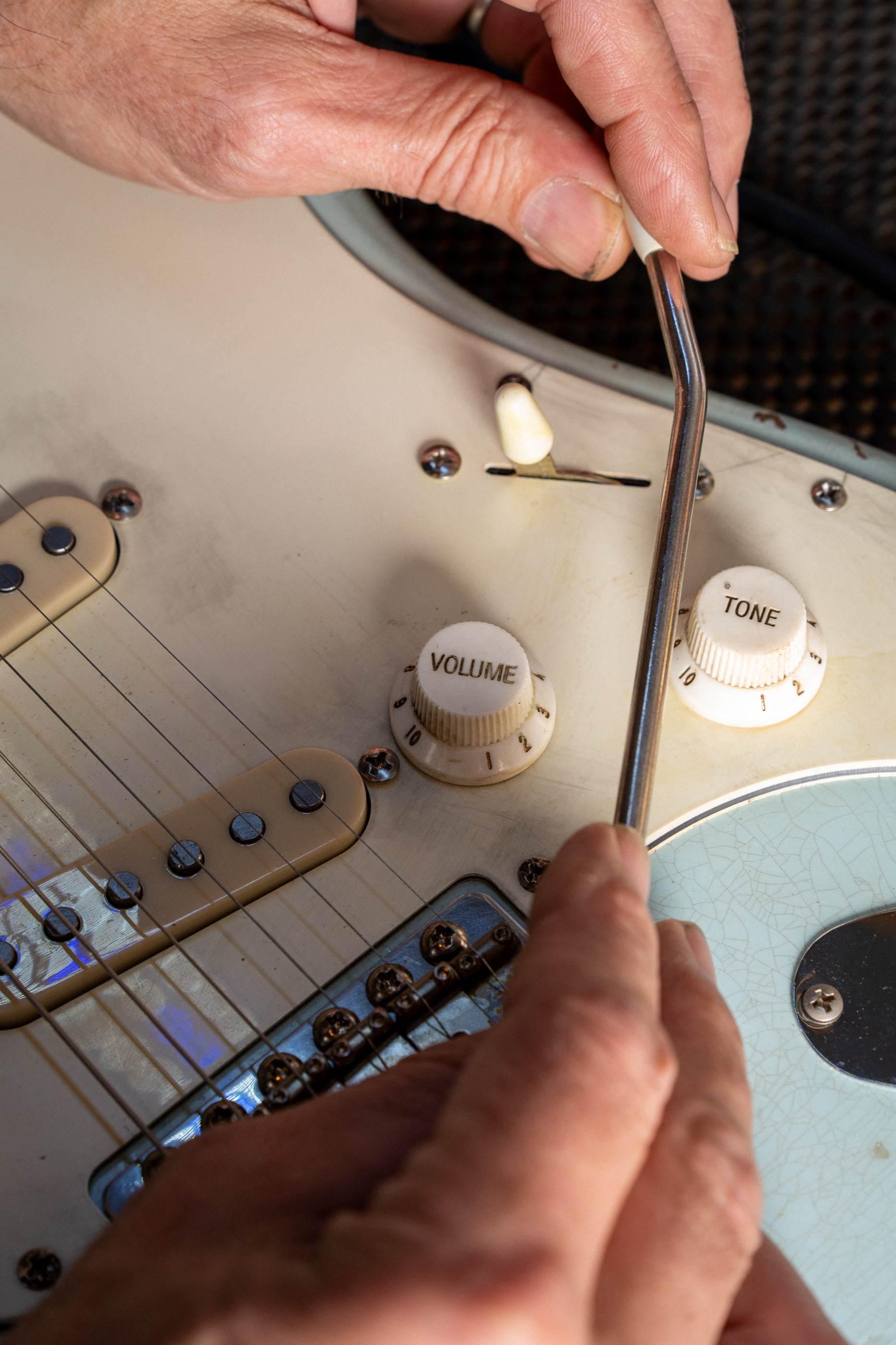
I do a fair amount of research, just looking at pictures of old guitars, and picturing how they got those particular injuries, for want of a better word. Sometimes it's easy and sometimes it's not. There's an awful lot of imagination in it, because you're making up stories: I wonder how that happened, I wonder how that happened. But at the end of the day dings and dents and wear do happen, and if you look at enough guitars you know where it's going to happen the most. Let's be honest, if you've played a guitar for more than about ten years you know exactly where it's going to get dinged the most and most often. And there are a wealth of guitar heroes with particular guitars and particular wear where the stories are very easy to research, whether they're true or not.
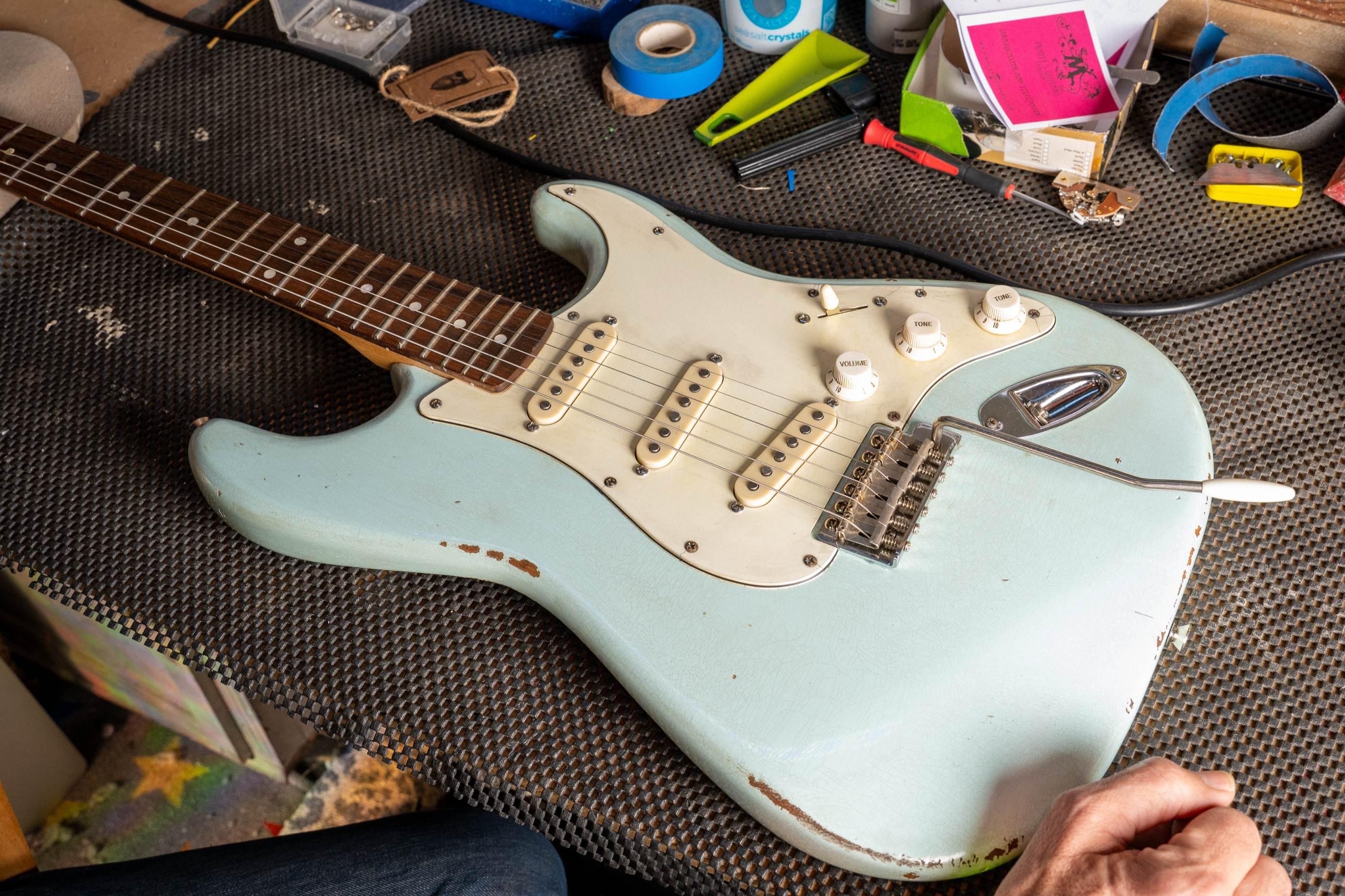
I always put the guitar together before I start, so I've got the complete picture. I'm at the stage now where I know where certain wear is going to be, and the wear on the edge I could do with my eyes shut, not literally, but I always make a point of it. Then when I start, I'll give the client a photo of it looking pretty much showroom, with lots of handwritten notes all over it that they can read: the heavier wear here, the lighter wear there. Usually it's very simple.
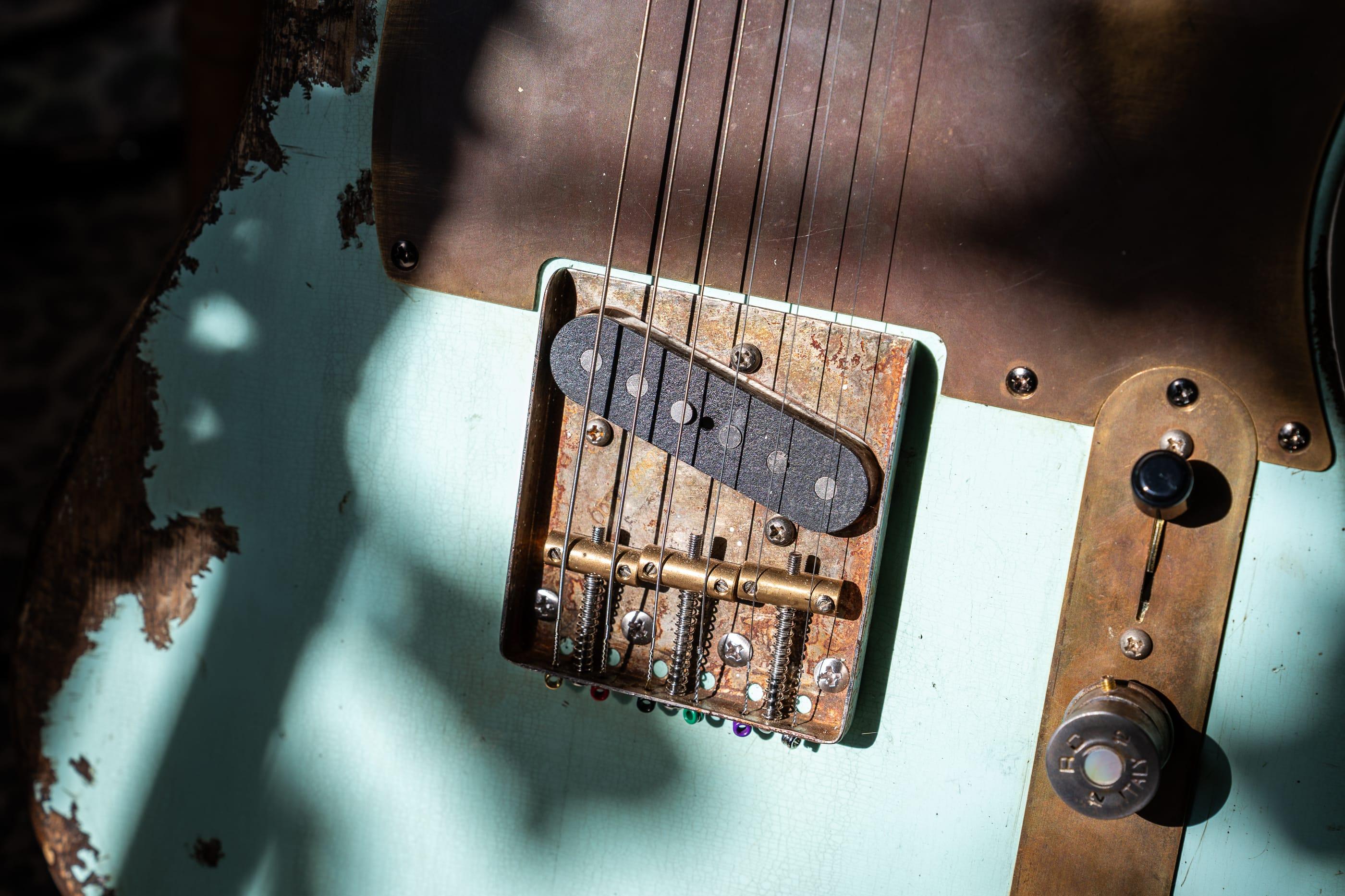
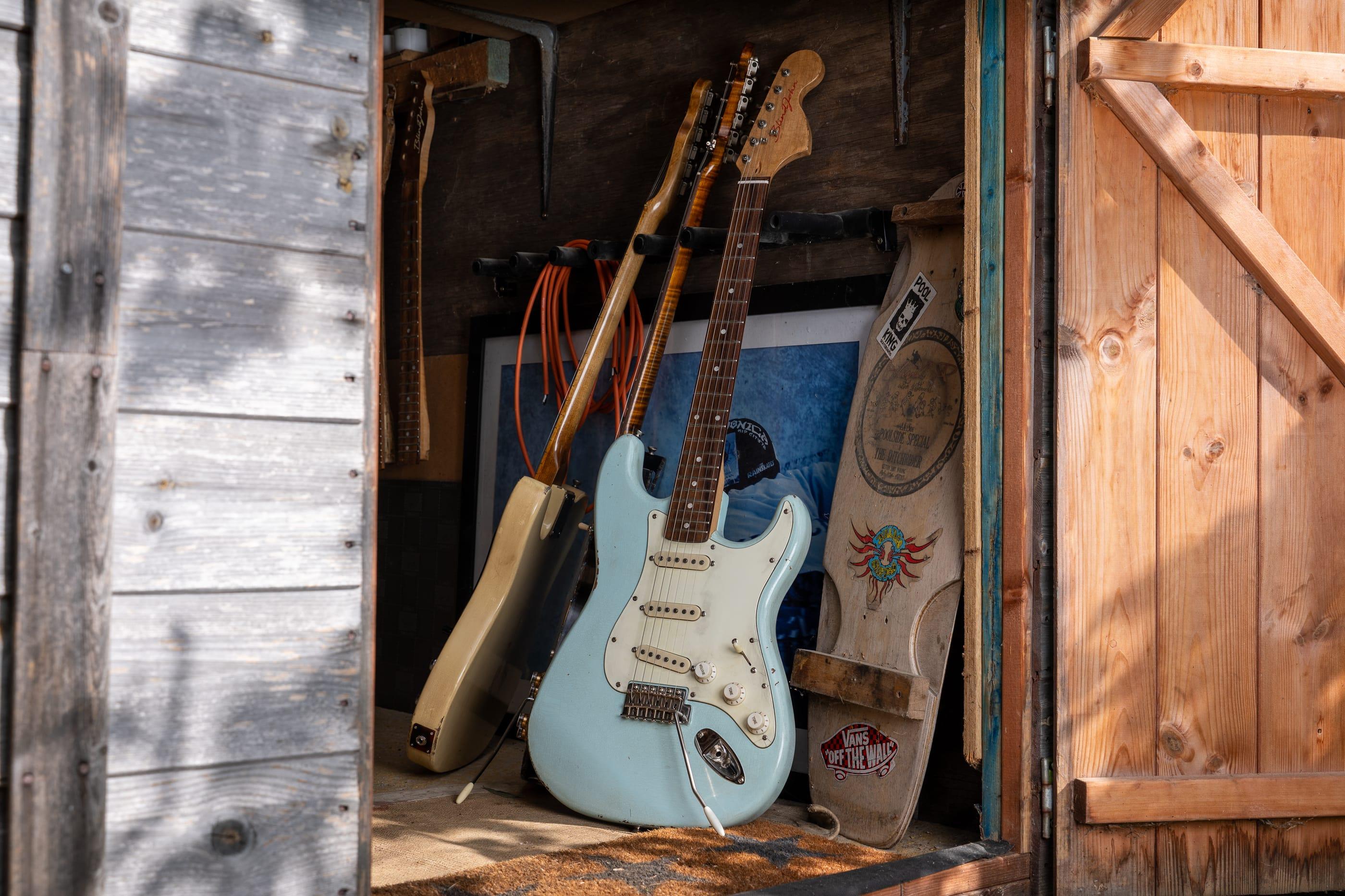
Take Echo. I wanted it to look like it had been used in a studio since it was bought, which it pretty much does. It's grimy. The checking's fine. There's the darkening next to the selector screw. The cracks in the pickguard aren't cracks, they're made to look like that, but you'd think they were. And there's more wear on the bottom edge, from where it's been put down and picked up, which is the wear you'd find if it had genuinely been doing that for that long. To get that look, my first move was literally to search for guitars that have been in studios since they were born. You'd be amazed what you can find if you're prepared to sit and go down that rabbit hole for long enough.
The paint. Thin coats crack fine. Thick coats crack wide.
The relic process is different for most of us. It's a bizarre, messed-up, insanely empirical thing, and we all have our odd little tools. I have a six-inch metal bar with about three inches of really dull thread on one end. That's one of my favourites. Then there's knowing how the lacquer and the paint are going to craze. Put simply: thin coats, lots of thin coats, flattened, will crack very fine. Thicker, heavier coats will crack much wider. So the painting is done with the relicing in mind. I want the paint to react a certain way when I start on it, so I paint it that way.
It has to be believable. That's the magic word, and I think that is what tasteful is: when it's believable. I have done some that are completely unbelievable, that look like they've been to hell and back. But that was the design, the client's request. And I'd rein it back from calling it design, because I don't think it is. It's replication of what you know that wear would look like in reality. You can still overwork one area against another, and that's wrong.
After it leaves. It'll wear with the owner.
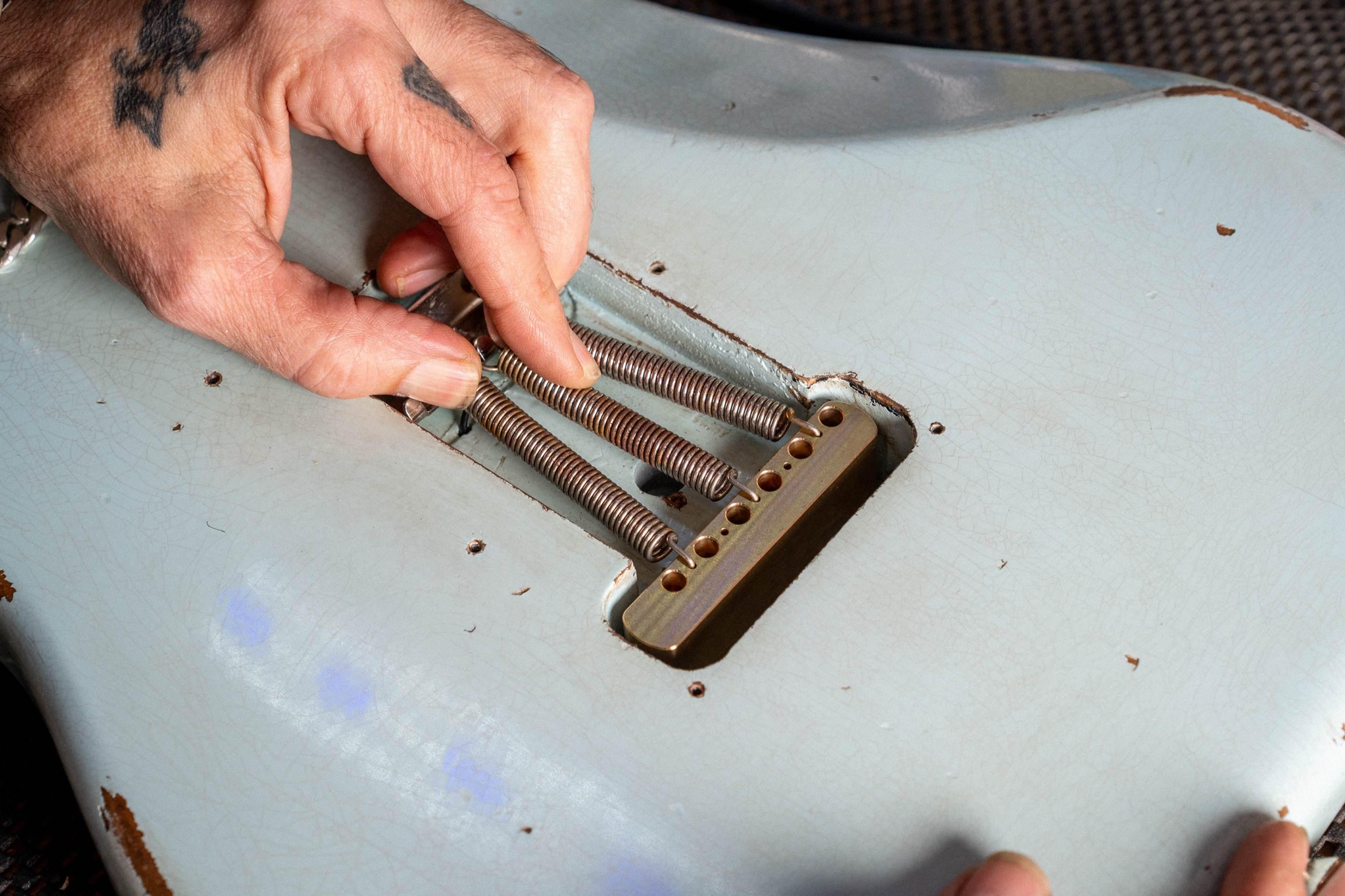
Where I've exposed wood, it's genuinely exposed. It means that once you get a chip in the paintwork, the chip is likely to grow. I wouldn't call it accelerated wear. I like to think it'll wear with the owner, and it will wear with the owner. The finish being nitro means it'll break down slowly, it'll craze more, but it'll do that with them. So all the stories it picks up along the way are as genuine as the wear and tear that particular person has put it through. You're starting at a later point in its appearance, that's all.
Before you start. Be sure. We can't go back.
This applies to any relic'd guitar. My ideal client comes to me with two statements: what they want the guitar to sound like, and the sort of wear they'd like on it. When I say sort of, I mean look at Rory's sunburst Strat that went to auction. There's almost no paint left on it. Literally. A couple of small patches on the front and that's it, and the back isn't much better. Other than that it's bare wood. If that's the level you want to see, not a problem. But be sure, because we can't go back. And I'd still paint it in full and then bring it back.
How long. The biggest time is when it sits there curing.
A light relic, been in a studio a few years, nothing serious, is the quick end. Take it to Rory Gallagher levels, or beyond, and you're looking at the upper end of the lead time. But the biggest time is when it sits there curing. That's four to six weeks of the undercoat, the paint and the lacquer flashing their gases off. Nitro is a chemical reaction: once the chemicals are put together they take time to go off, and in doing so they vent off all the cellulose vapour over a period of time. It's not until all that vapour has actually gassed out of the finish that it's completely cured, and that's when I start the relicing. You can start before. You won't get the same results, and if you start too early you won't get any results.
Stencils. No two guitars wear the same.
I remember watching a thing where Tom Murphy was talking about how he relics stuff. He's got a set of keys, and he's had that set replicated for everybody who works in the shop, so everybody has the same keys. They use them for certain dinks, tapping the keys off the guitar, and it doesn't matter who's doing it, it's always going to be roughly the same, because they set a key. I thought that was hilarious.
Then there's stencils, which is something Fender actually did a while back, and I was a bit disappointed about it. I clocked it once quite by accident. There were three of the same series of Fender relic guitars on Reverb, all different colours, and I suddenly went: hang on a minute. You could literally lay one over the other. The wear was exactly the same. The only way you can do that is a stencil. If you're turning out a series of them you're going to use templates, and you're not waiting six weeks for it to cure, either.
No two guitars would ever wear exactly the same. Even if the same guitarist was playing them, they'd be slightly different. I can't do that. I wouldn't use a stencil anyway, but I couldn't. It doesn't work for me.
| Recorded | 6 October 2026 |
|---|---|
| How | A cup of tea and a microphone, cut, not written |
| Who | John |