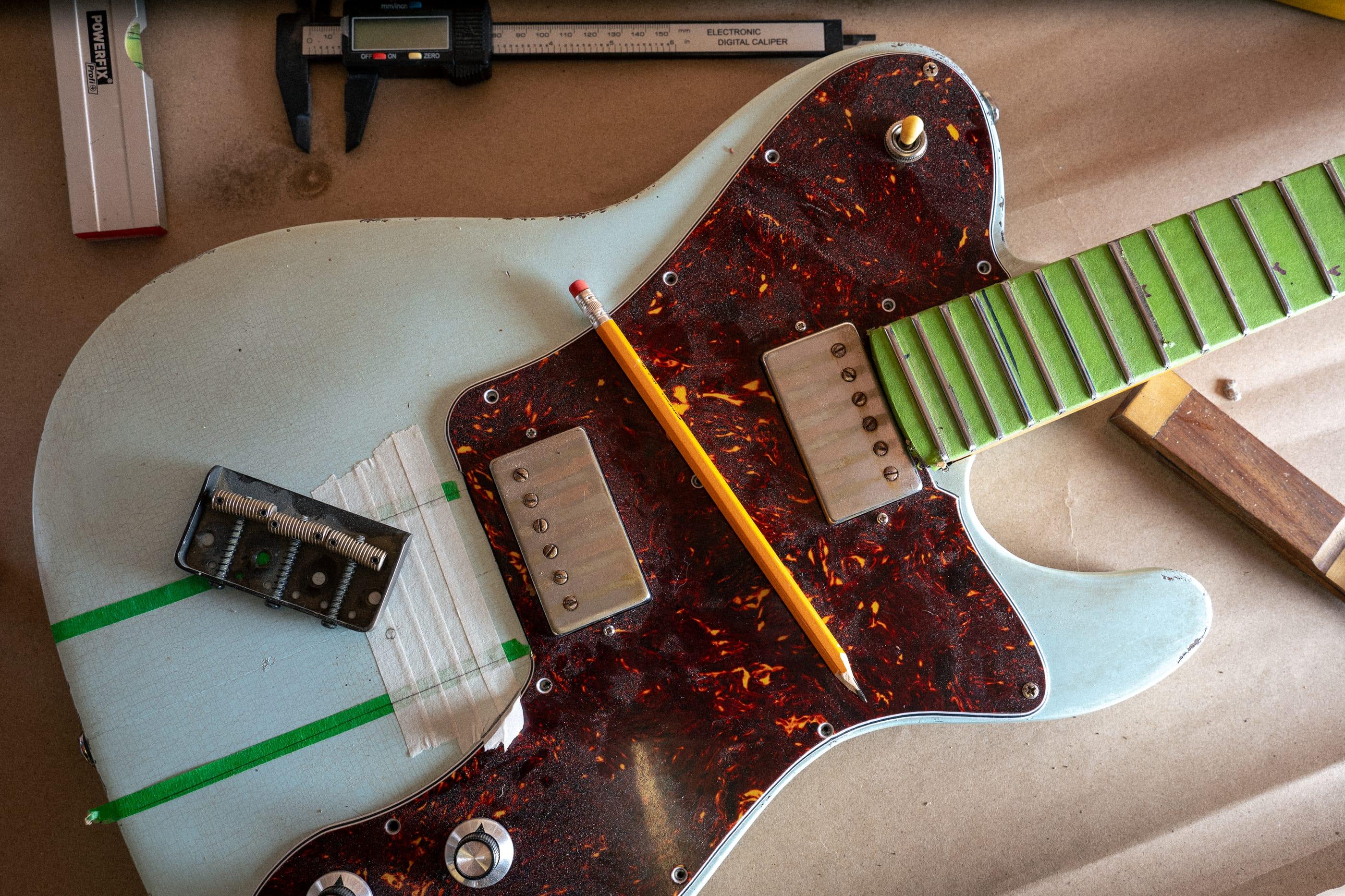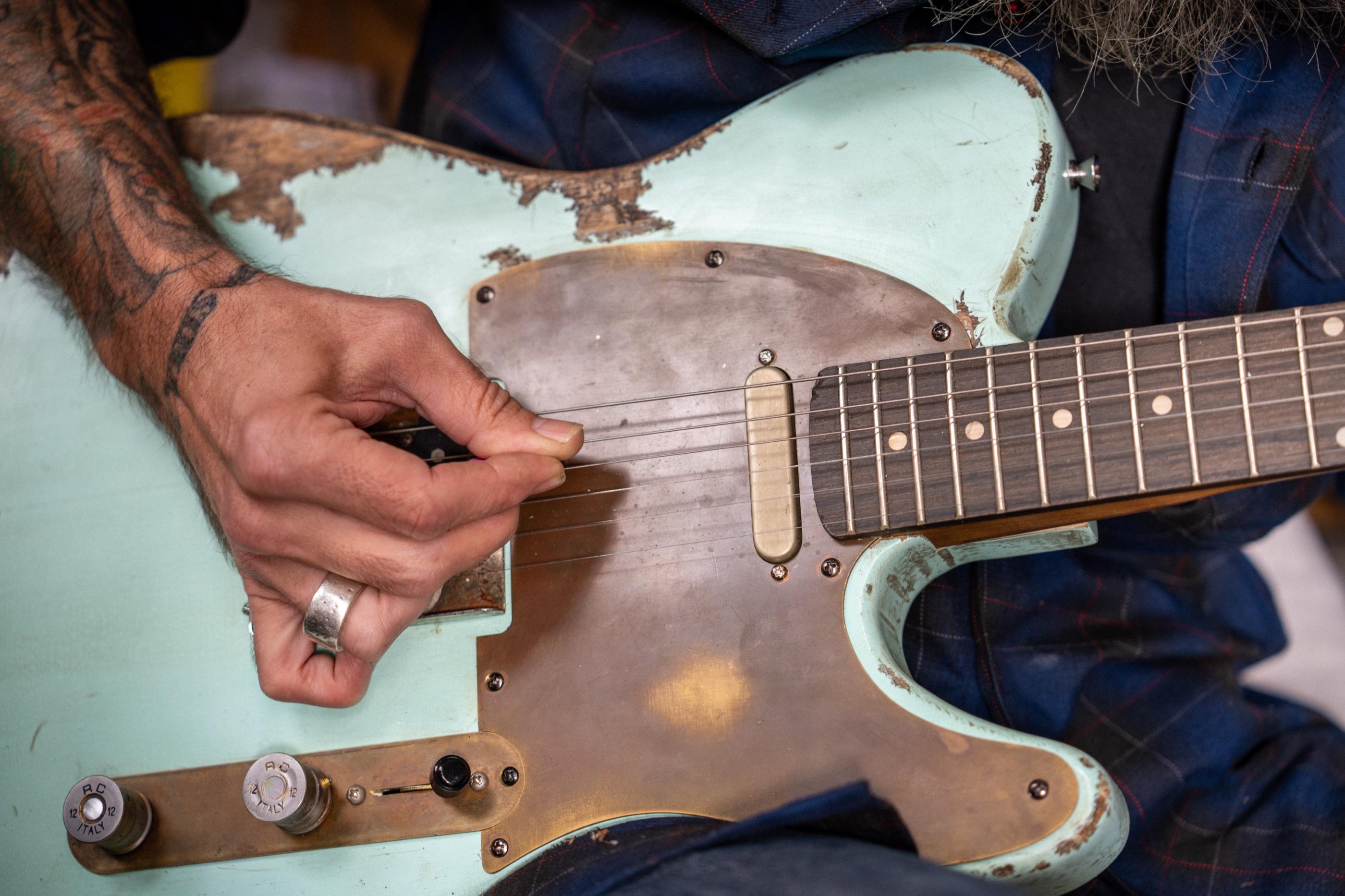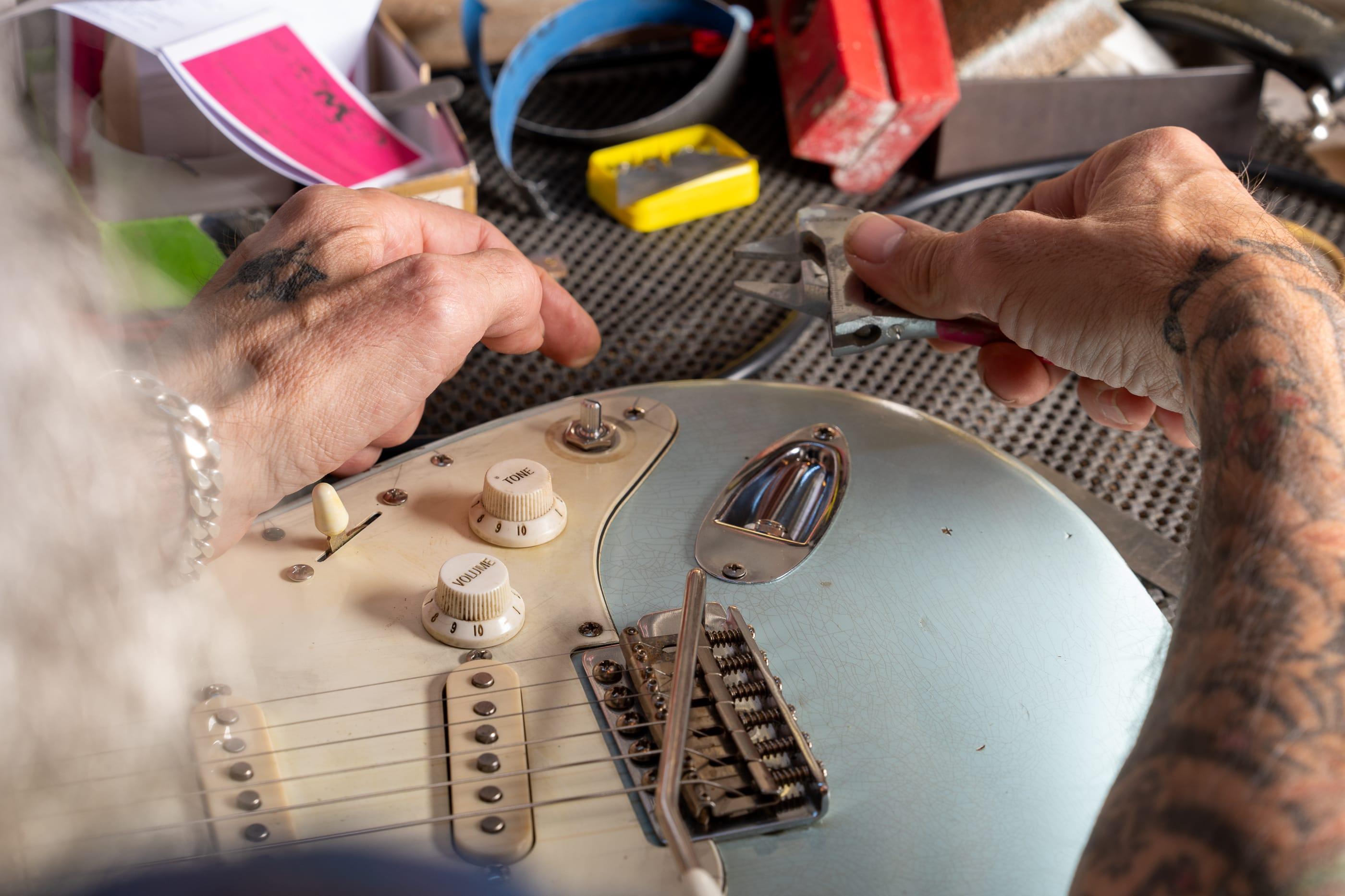
A loaded Strat pickguard drops straight in
Loaded against prewired, relic'd to match the guitar it's going into, the pots and the tone cap, which pickups and how to choose them, and how long it takes.
Loaded or prewired. It should just drop in.
With a Strat, a loaded pickguard should just drop in. The only thing you'd have to do is connect the output jack. That's it. Connect that up through the hole, drop it in, put the screws in, string it up, and you're good to go.
It would require a little bit of soldering. But soldering two lugs to an output jack isn't out of the realms of most people's ability. Or it shouldn't be. Pre-soldered, with a connector? I'd have to supply the output jack, and depending on the guitar it may require re-drilling to get that connector through.
Prewired, to me, would imply that the loom is in there but the pickups aren't. Loaded, to me, would imply that everything's there apart from the output jack. But then some guitars have the output jack on the pickguard. A Gibson Melody Maker, the output jack is on the pickguard. It's part of that shape. So there are guitars that would have that, but not all. Some would require some soldering and some wouldn't.
Relic'd to match. It would be almost rude not to.
Would I relic it to match the guitar it's going into? I think it would be almost rude not to. Being that I'm known for my relicing, and it's the biggest part of what I do, to offer just a new pickguard, that's not really why people come to me.
By photo, or bring the guitar in. Details like guitar, year, make, model, et cetera, I would need.
What goes on it. I won't use cheap, nasty components.
Some people aren't really bothered about quality electrical components. I am. I won't use cheap, nasty components. I tend to use CTS pots across the board, and with those you have different options. No-tone pots, or different tapers for the volume and the tone, so you don't have it go from 10 to 9 and then at 8 you have nothing, it drops off. That's down to how the ear perceives a drop-off in body or tone. The curve, logarithmic or audio, is going to be different. And with the better ones like CTS you can get different tolerances deliberately, if you like a wider sweep on the tone control, or if you don't.
I'm not going to scrimp on things like tone caps or volume or tone pots or switches, simply because a cheap, nasty one is never going to be as reliable. The tolerances are going to be very, very different.
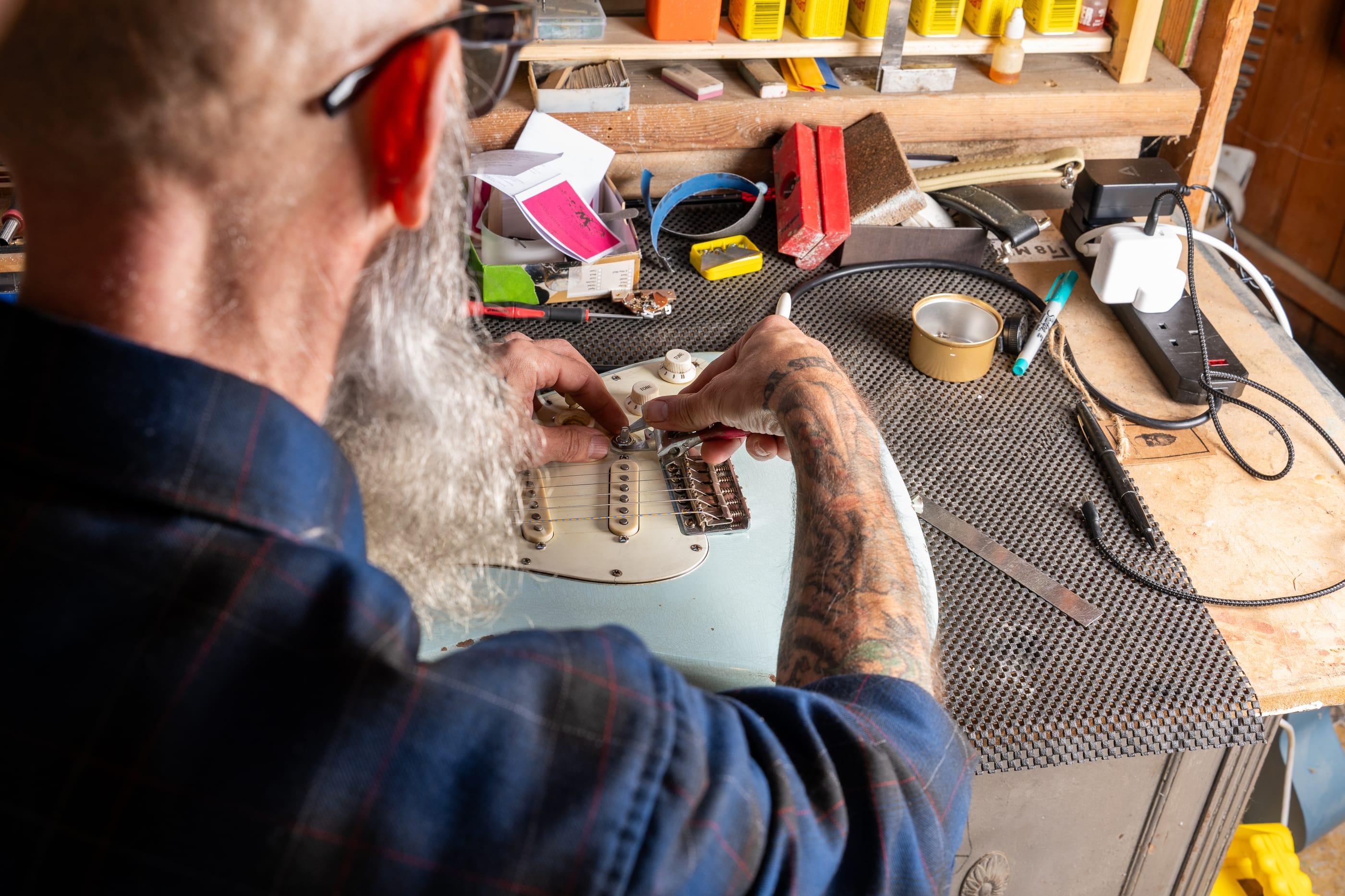
You could have vintage wiring or modern wiring.
The tone cap. A bit like the tonewood argument.
Tone capacitors are one of those arguments that's a bit like tonewoods, where some folks say it's old bollocks, it doesn't mean anything, and others say no, it does matter. I think it does, in all honesty.
A tone cap is basically what filters the highs or lows out of your signal when you turn the tone control. They all have one. Originally they were paper and oil. You can get Mylar ones now. A vintage paper and oil can set you back anything up to 150, 200 quid if you're buying a genuine vintage late-fifties Bumblebee tone cap, whereas a Mylar tone cap will probably cost you 10p. There are varying capacitance ratings, which again can darken the sound or brighten the sound. The value of the tone cap does affect the sound.
The one on my bench has a period-correct early sixties cap, what they call a phone book, originally made by Dubilier. I've favoured vintage tone caps for years, when I can get them. They are getting rarer. Then I discovered a company called Luxe, who make the most amazing reproductions, even down to the machines they're made on. The Sprague reproductions they do are made on a vintage 1934 Sprague machine that they would have used back then. They don't come cheap.
Whether they're any better than a vintage one, I couldn't actually tell you. I'm not even sure I could tell the difference. But in an AB test I think you can tell the difference between a good paper and oil cap, like one from Luxe, and a crappy cheap Mylar one. Some folks will argue that you can't tell the difference. It's a bit like that tonewood argument. Does it make a difference? Yeah, I think it does. Again, it's more of the whole thing.
Which pickups. Your imagination really is the only limit.
On a Strat there are usually two options people gravitate towards. There's the traditional three single coils, or the HSS, which is a humbucker in the bridge, a single coil in the middle and a single in the neck. Then again, you can go different ways. Ariel Posen plays an S-type guitar with, I think, two humbuckers, not three pickups. So there's a huge amount of variation you can have. Your imagination really is the only limit. And with pickups being voiced differently, the options there become massive.
A Tele's different. On a traditional Tele pickguard you would only have the neck pickup, so you couldn't really do a loaded Tele pickguard unless you were doing a '72 Deluxe reissue. It works with Strat pickguards.
And HSS? You couldn't drop an HSS pickguard straight into a stock Squier or a stock Fender unless it was already configured for HSS. That would require routing of the body.
Choosing them. What do you want it to sound like?
All the usual questions are just as valid for a loaded pickguard as they are for a full custom guitar. Where dealing with clients is concerned, it's easier to go down that route: what do you play, what do you like to play, what do you want it to sound like?
If someone says, I've got a black Strat and I want it to sound just like John Mayer, well, there's a few companies that specialise in that. Monty's have a couple of great sets designed and voiced to sound like John Mayer's Strats. If Monty's don't do that specific thing off the rack, not that they won't do other things, I could go to Sean at Old Bones and say: right, Sean, I want two humbuckers, I want them to sound like this, the client plays this, they do that. That's what boutique pickup makers do.
I've had people come to me with a pickguard and a box of brand new pickups and say: I want a loaded pickguard. There you go. So for me it's just a question then of relicing the pickguard, the type of wear that's on it, the knobs, the pickup covers.
The covers. You can fuck up a pickup very, very quickly.
If it's a Strat, all the colours you would see on different Strats are available. The plastic ones, anyway. It's a little different if it's a metal-covered humbucker: a grille style, or the traditional six pole pieces showing, and the list goes on.
It becomes a little bit different if they want brand new pickups and they want them relic'd. Then ideally I would like the covers sent to me from the pickup maker first, so I can relic those, then send those back for them to put on the pickups. Because you can fuck up a pickup very, very quickly. I have done it, and will no doubt do it again. It's something you have to be incredibly careful with.
How long. Way, way shorter.
Way, way shorter than a full custom guitar. Even relic'd, with a couple of tone modifications, a couple of days, if the stuff's in stock. I'd probably ask for seven working days. That gives me time to get the parts. Volume pots, tone pots, I usually have those in stock. That's the sort of consumables I usually have in.
| Recorded | 27 October 2026 |
|---|---|
| How | A cup of tea and a microphone, cut, not written |
| Who | John |