A custom pickguard that ages with the guitar
Bakelite to celluloid acetate, why the guard is always relic'd with the body, colour that runs all the way through, the copper behind it, and why a guard for your guitar starts with your guitar.
What they're made of. Back in the fifties it was Bakelite.
Traditionally, back in the fifties, it was Bakelite. Then they moved to celluloid acetate, and then to some sort of polystyrene, Perspex-type material. I'm not entirely sure exactly. Cost saving, and health and safety. Bakelite is not nice to work, and not particularly good for you, and it's not really made any more. I can get Bakelite ones, and I did a while back, but they are expensive, just because there are very few people making them now.
However, there is something about the Bakelite that does work. Plus it was often Bakelite that was sprayed, top-coated, so that again will age differently to the Bakelite itself.
Relic'd with the guitar. Absolutely and utterly always.
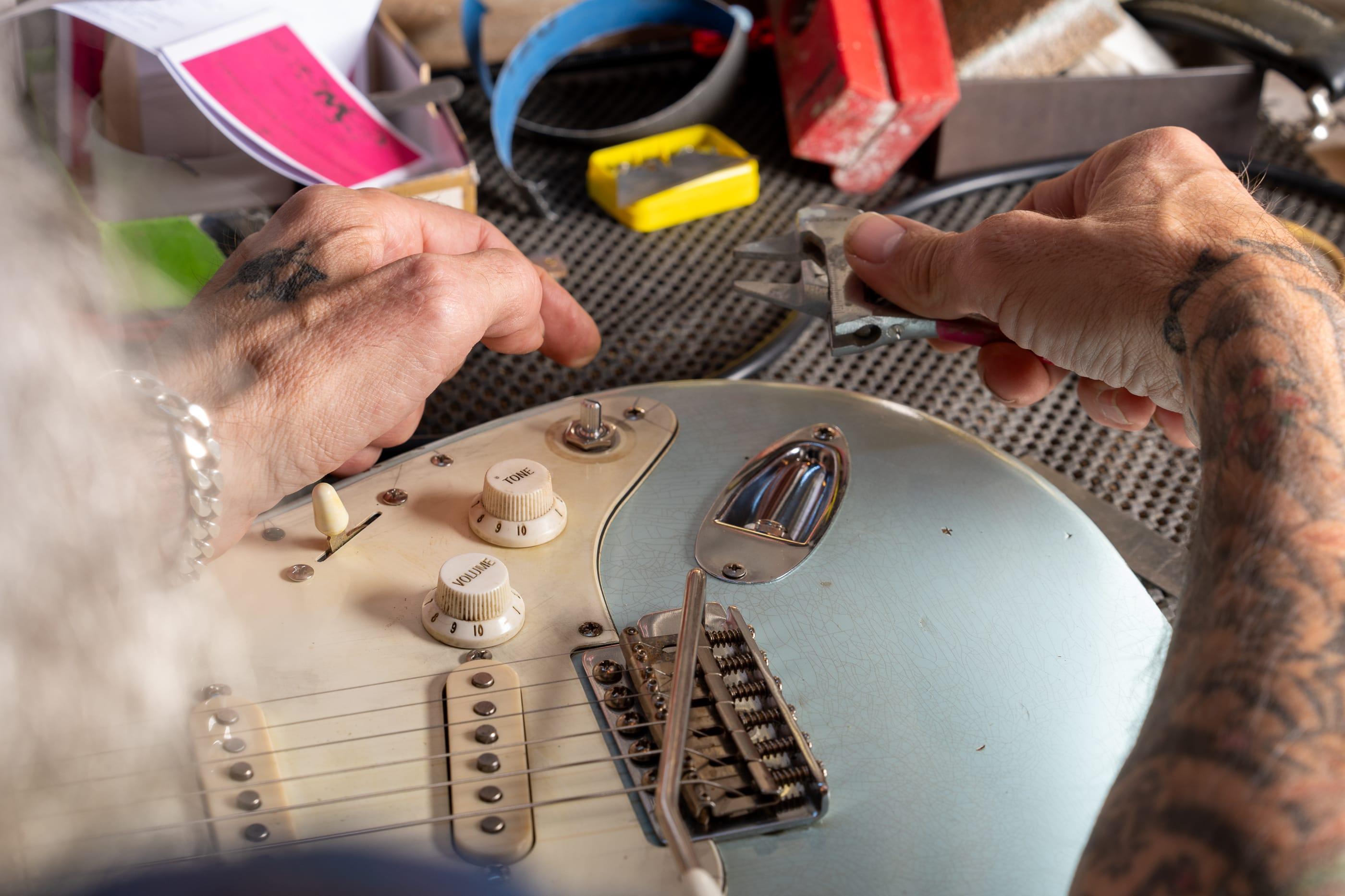
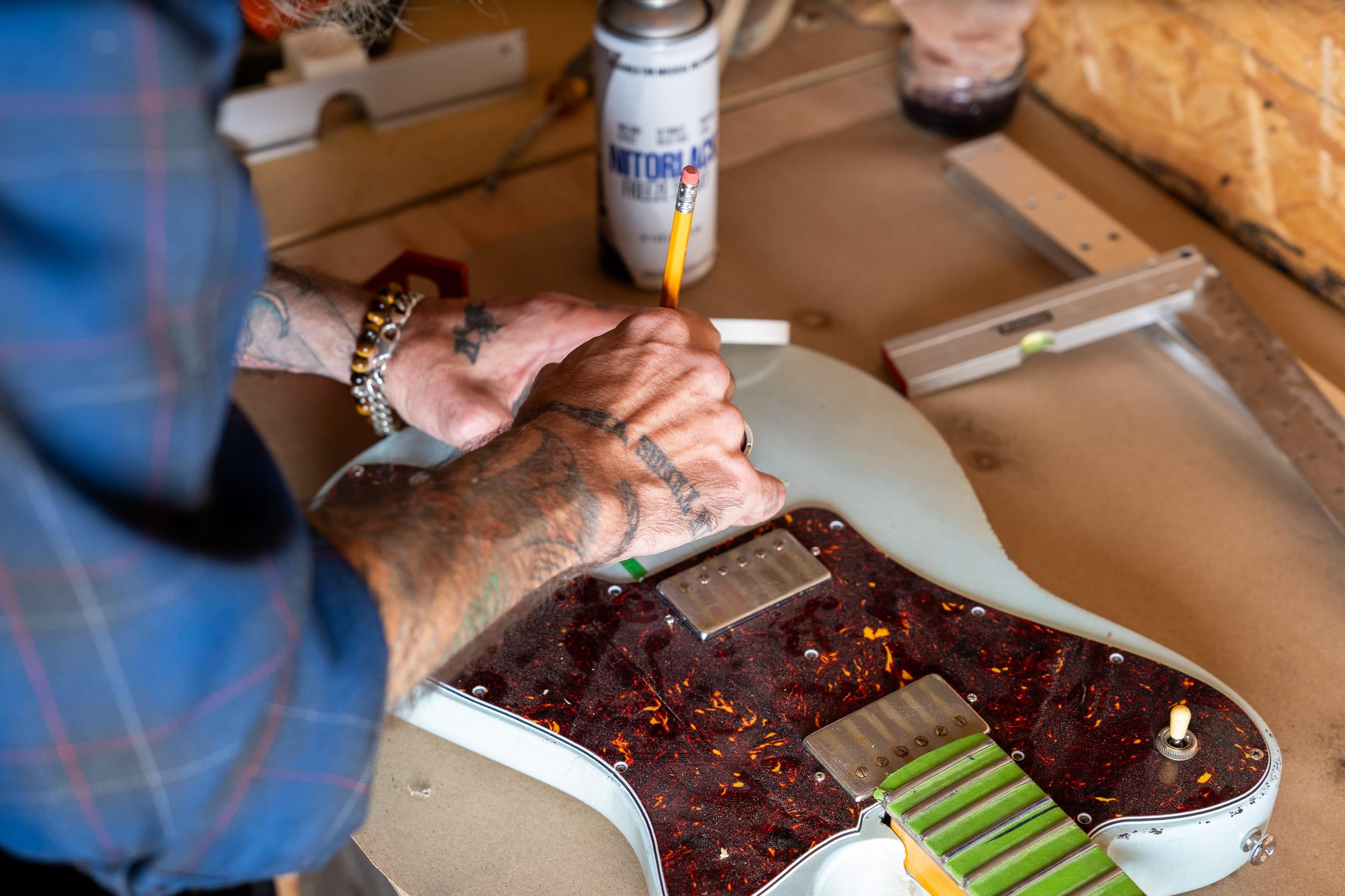
When I'm making a guitar, is the pickguard relic'd to match the body? Always. Absolutely and utterly always. Do I make my own? Both. The one on my bench I didn't make, but it is still relic'd. Under the knobs it has the ring.
I regularly go through Instagram looking at relic guitars, and there are a huge amount of, I'm not going to say bad, because that's a bit unfair, but average relic jobs. And sometimes actually quite good relic jobs, where they haven't relic'd the pickguard or some of the hardware, and it's like: well, hang on a minute. It doesn't work like that. Nothing would age like that.
I've always found that a little bit odd. I was actually asked for it once. It was a refinish I did quite a lot of years ago, quite early on, and the client wanted the body relic'd but not the hardware. In the end they changed their mind. But to me: why? That's a bit like buying a vintage guitar and replacing all the lovely patina'd parts with new.
Celluloid acetate. It runs all the way through.
Obviously there's the traditional single-ply, two-ply, three-ply that you see on all guitars, but I've recently been using celluloid acetate. The stuff I use is a little bit thicker than the stock. I think stock is about 3mm. The celluloid acetate I use is about 4mm.
Why? You can age it better. It looks more genuine than some of the newer pickguards I've seen. Some stuff just doesn't wear. It just doesn't relic. You can't do it. It took me a long time to work out how to relic the modern-style pickguards. The celluloid acetate I'm using now is all hand-cut, hand-shaped, hand-relic'd, like everything else I do, and it works beautifully. It cuts lovely, it sands lovely, it polishes lovely, it relics nicely. You can put the sort of wear in it where, fifty years of playing a guitar hard, you're going to wear a divot in the pickguard. It's not just going to be surface scratches. You are going to wear into the actual plastic.
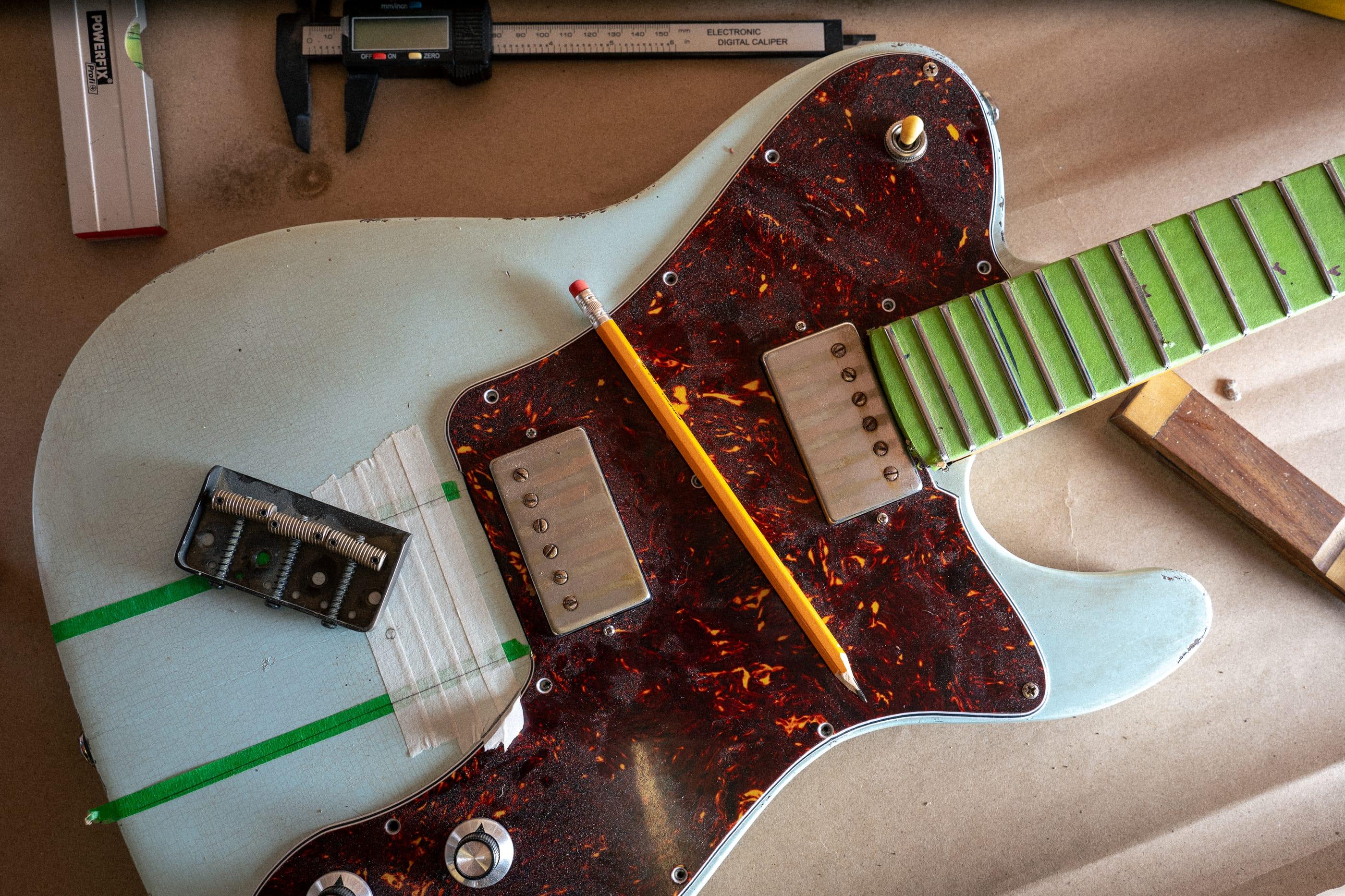
It comes in the same kind of colours as any pickguard. Pearloid, aged white, mint green, all the usual colours, pretty much all of them in acetate. The difference is, take a tortoiseshell. On a three-ply it's black, white, tort, and the tort on top is the thinnest layer. It's still a layer, but it's just a cover on the top. With the celluloid acetate it's all the way through. It runs through it, not just across the top surface. It's not a laminated set like the three-plies are. It's one piece.
And with that, particularly where tort's concerned, the different styles of tortoiseshell, you get a depth of colour that you don't get with the modern ones. Look at the 107, which has a dark tort guard, and the surf green Kid on the website. That's also celluloid acetate. You can see from both of those, the depth of colour is stunning. And even knocked back, so it becomes matte, you still get that lustre to it.
The copper behind it. Quite by accident.
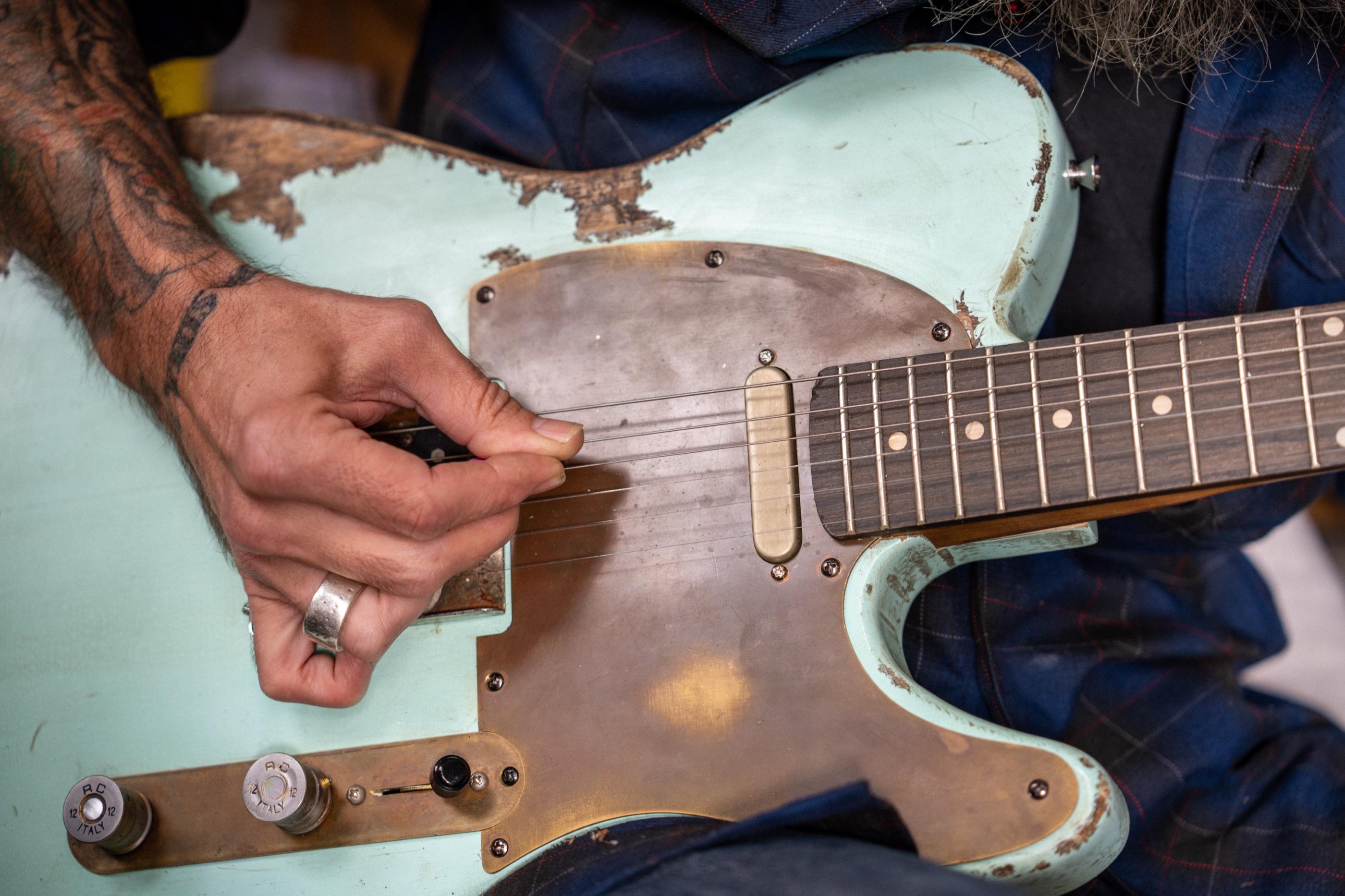
Something I did recently, on a sample, that at some point I will use on a guitar, was quite by accident. I happened to be copper-foiling a cavity, I had a little sample piece, I happened to put it down, and it got stuck to the back of the copper foil. The way that accentuated the colour was beautiful. Absolutely beautiful.
So at some point I think I'll be doing that. Probably not with the copper foil, because it's tape, it's narrow and it's expensive to do it with. I'd probably get very, very thin sheets of copper, cut the same shape as the pickguard, and back it. Because the depth of colour then, I mean, it was stunning.
What I won't use. It was fucking awful.
I can be a bit funny with pickguards. There's a lot that I look at and go: it's horrific. Yes, I have seen some folks make them work superbly well. I bought a sheet a while back of the normal three-ply, an A3 sheet, a bit more than A3, around that size. I forget what it was meant to be, but it was fucking awful. It's leant up in the workshop and everybody that sees it does a double take. What the hell is that? I think it's meant to be abalone. It's almost become a side project in the back of my head: what can I actually use this shit for? I haven't yet thought of anything that's going to work.
Made for your guitar. I'd want to know exactly what guitar it was.
A custom pickguard would need to match the screw holes on that particular guitar. There are also slightly different shapes from manufacturer to manufacturer. Put a USA Tele and a Squier Tele next to each other and the pickguards look almost identical. They're not. They do not fit each other. They are not interchangeable.
Same thing for Strats. Japanese pickguards are slightly different. The bridge pickup screw hole moves at a certain date. The Squiers and the USA ones are different: different hole placements, different numbers of holes. There's a whole load of variables.
If somebody asked me for a custom pickguard, I'd want to know exactly what guitar it was, what year, what manufacturer. But ideally, I'd like the pickguard. Then I guarantee it's going to be exactly the same shape.
The cracks. They aren't actually splits.
It really depends on what the customer wants. On Echo, I've simulated the cracks where the screw holes are, because the holes are a weak point. You can see what looks like a split from the edge of the screw hole to the edge of the guard. They aren't actually splits. They just look like that.
Sometimes I have actually done splits and tiny gaps, as though it's cracked over the years and then shrunk, and obviously that gap widens. That does actually mean taking a piece out. But if I was doing that, I probably wouldn't be using celluloid acetate. For one, I don't believe you can get it in three-ply. So it would depend what the client wanted.
For my guitars, particularly if it's a tortoiseshell or that type of finish, I'd use celluloid acetate, just because of that depth of colour, the lustre, the way you can work it and finish it. If somebody wanted more period-correct, I'd probably use a more traditional material, like a normal three-ply.
| Recorded | 27 October 2026 |
|---|---|
| How | A cup of tea and a microphone, cut, not written |
| Who | John |