
What would that sound like?
Guitars that started out as a question of sound we just had to build to find out. Each a Tone Control one of one, tuned up, ready to play. Here’s what we have, and what we’ve had.
A fantasy Strat, '62 and all in blue, made to look like it's been round the block.
I've always loved a Strat, though I gravitate to the Tele. Mick Taylor on That Pedal Show has a sonic blue '62 reissue, and I thought: I'm going to make my ideal '62 Strat. Not a copy — exactly how I'd want it to feel, play and sound. Squier bodies are six mil thinner than the American ones and I like the feel of the thinner one, so I split the difference, three mil either way. Otherwise I took the Fender blueprints and went as close as I could. Monty's '62 pickups. A brass trem block rather than steel for a bit more sustain, set up floating — there's an art to that. A 9.5 radius rather than the original 7.25, built to be comfortable on nines. It was an entirely selfish build with no thought about what would sell, and it's a hundred per cent the sound that was in my head. Positions two and four are where I live on a Strat; you could take out the other three and I'd never miss them. It's got my name on the headstock, not Fender's, for obvious reasons. I'm going to be quite upset when it sells.
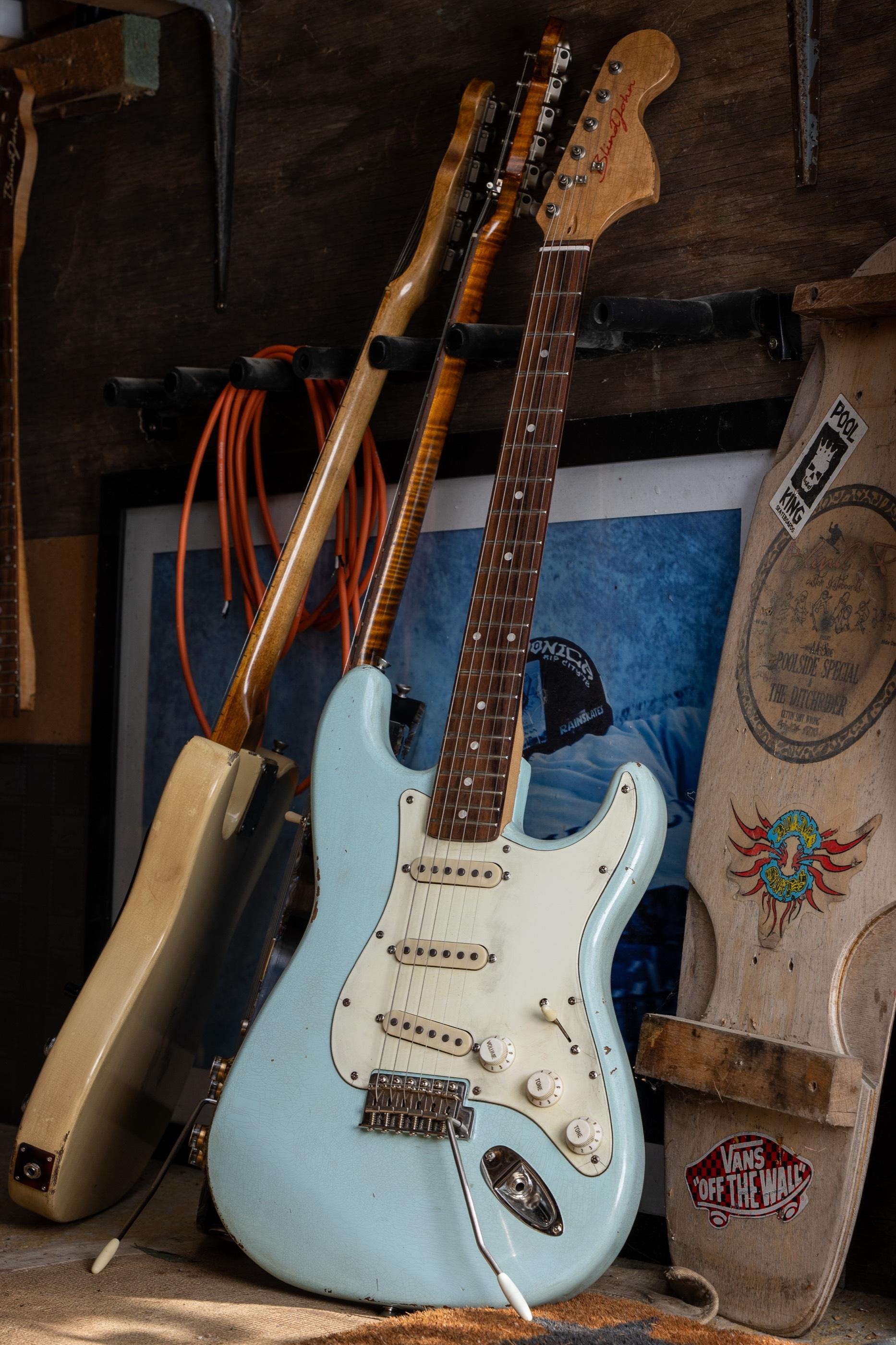
Built for tone, not decoration… but it looks damn good regardless.
I had a single piece of mahogany that wasn't big enough for a Strat or a Jazzmaster but was big enough for a Tele, and a couple of sheets of celluloid acetate — the stuff the old tortoiseshell guards were made from after Bakelite — that I wanted to try. That was the genesis. It worked, so I fancied a couple of things different: an angled selector rather than straight up and down, the traditional '50s domed knobs, and a Monty's '53, modelled on the original pickup from when the Esquire had one pickup and a very odd wiring system. I don't make many with maple necks — I prefer a darker board, ebony to look at — so this one's made as a two-piece, no skunk stripe, and the heavy wear on the board was an experiment in making a relic'd fingerboard convincing. I picked vintage white because in my head a really nicely aged, grubby vintage white would look good, and for once it did. From a distance it just looks grubby. Up close it's some of the finest checking I've done. It plays lovely and it sounds incredible.
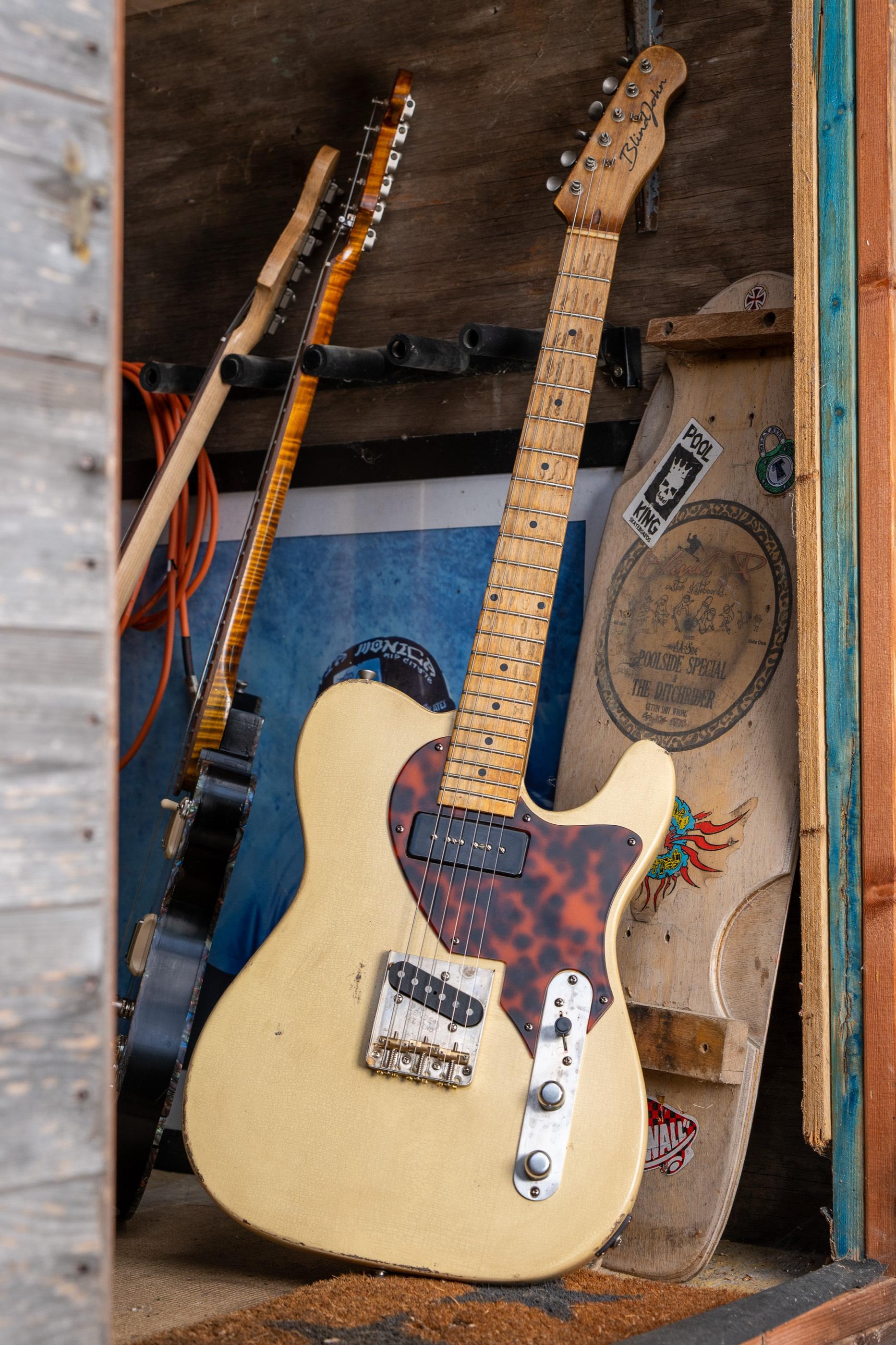
Every so often a lost idea returns…
I was sketching from an old thick-bodied Gibson jazz guitar, an ES-175 with a single P90 on it, and I loved the horn. So I swapped the curved horn for a much more aggressive point — not an aggressive shape, a point — thought, that really works, and put it aside. It got folded into a notebook and forgotten. Years later, moving bits from one notebook to the next, a post-it was stuck in the top, and on it was that design. Oh shit, I forgot about that. Fuck it, I'm making that next. So I did, and it took some working out, because a hollow Telecaster doesn't work with a Tele bridge, or with unpotted pickups, or with a hollow neck pocket. A heel block and a neck block solved it. It sounds glorious — a really rich, thick sound, particularly the neck pickup, which looks like a humbucker and is a humbucker-size P90. Once I'd finished it I decided the old Thickline was done. They're all going to have this point now.
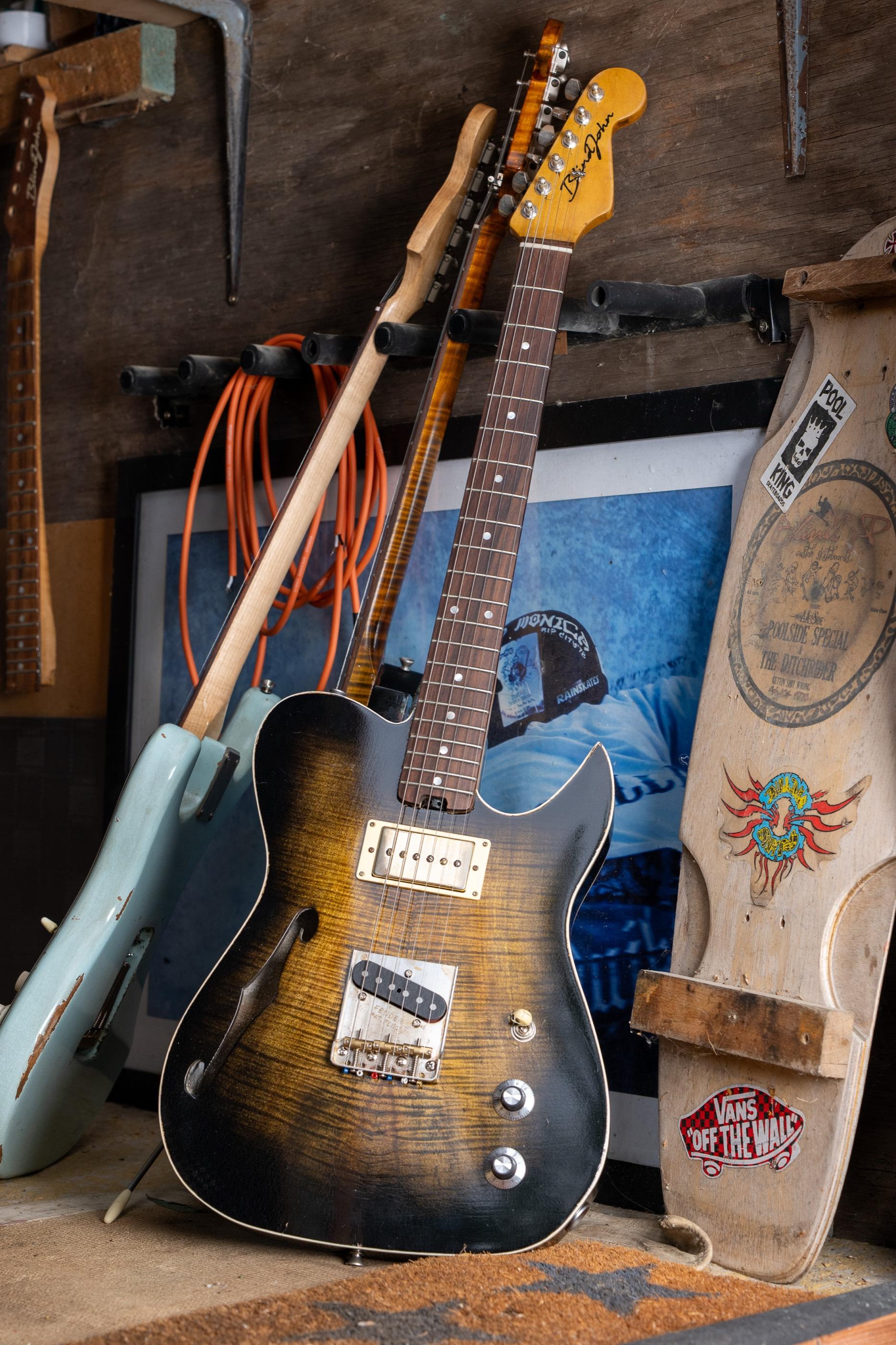
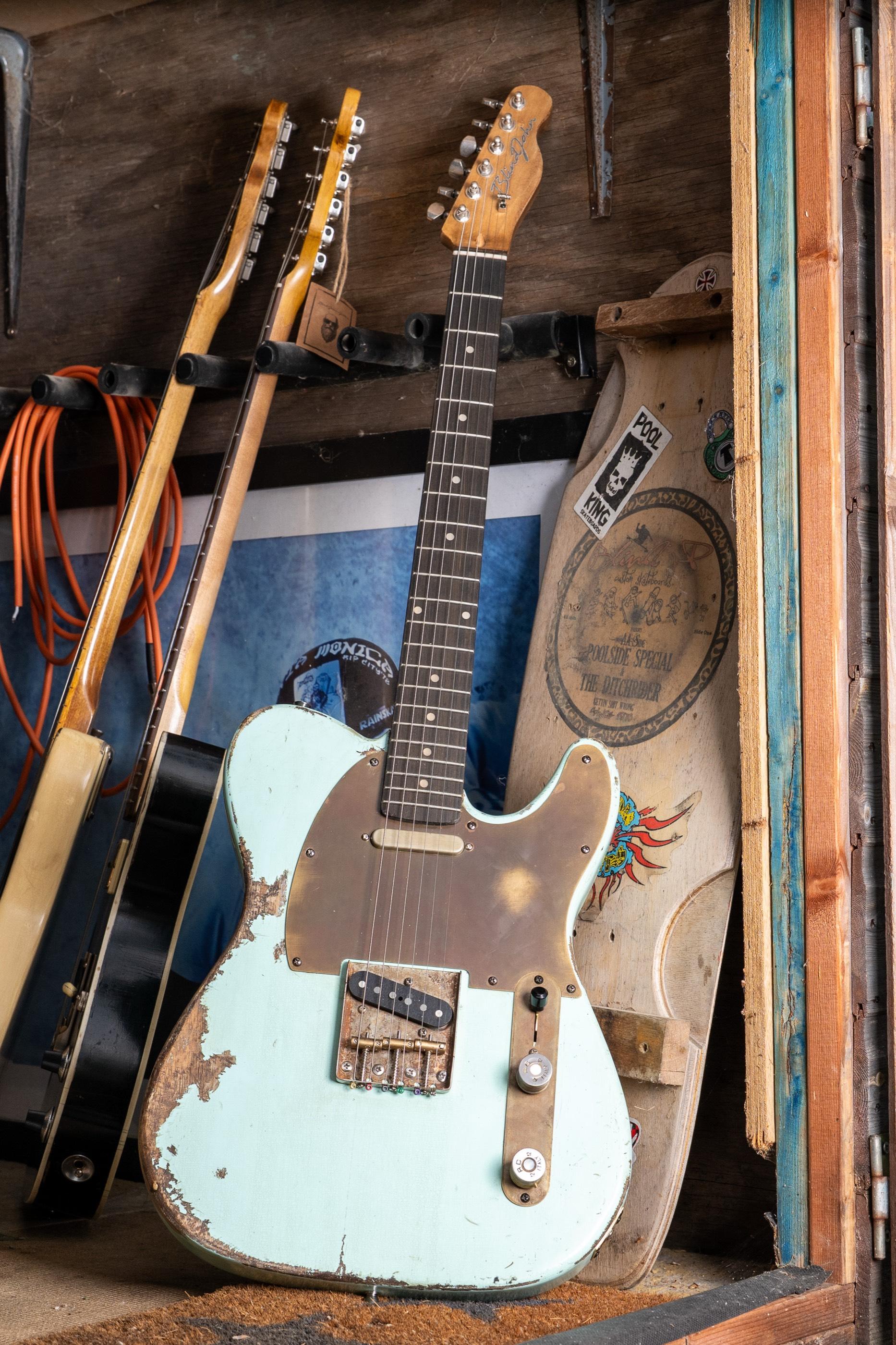
A beast of a T-type. Named the Runaway because with this beast… you ain't runnin' nowhere.
It came from thinking about the Thickline: I wondered what a solid-body Thickline would be. Korina — black limba, whatever you want to call it. It's thicker than a stock Tele by about ten mil and fractionally bigger all round, with a two-mil solid brass pickguard and control plate. Add all that together and it's heavier than a '50s Les Paul. It looks great and it plays, but it is a heavy guitar, and even sat down you notice it. I'm not a hundred per cent happy with it — I'm never a hundred per cent happy with any guitar, you have to learn to let go — but I may have let go of this one too early. It's called the Runaway because you ain't running far with it. I may yet turn it into a smuggler: hollowed out under the pickguard, the way a customs man once found a '60s Tele was, and the way we use now to lose weight.
These were our questions. A commission starts with yours.