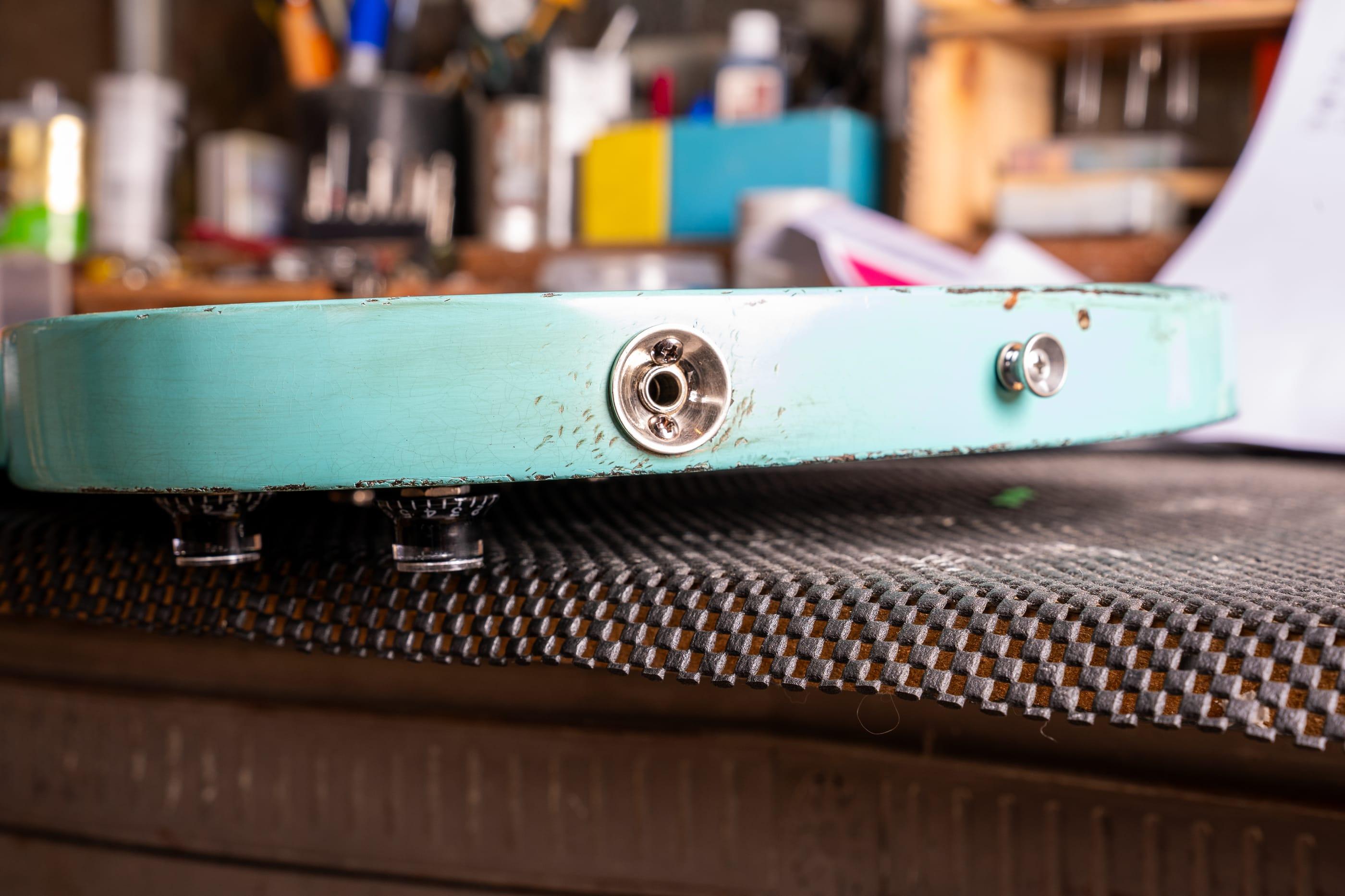
When a relic isn't a relic
Rolled edges, a bare neck, the tide mark under the pickguard and the ring under the strap button. Comfort first, convincing second.
Somebody on a podcast a few years ago was talking about something he has done to every guitar: the edges of the fingerboard rolled. Now technically that's relicing, because it only happens with time and playing. Run your hand up and down the edge of a new fretboard and you've got a right angle. Near enough. And if the fret ends aren't ground properly — a real bugbear of mine; I had a brand-new three-grand guitar through the workshop recently and the fret ends would literally slice your finger — it's worse.
I wouldn't let a guitar leave my workshop without rolled edges. It feels so much nicer to play. If it feels nicer, it's going to play nicer. If it plays nicer, you're going to play more. Simple as that. I do it on services too: do you want the edges rolled? What does that do? I hand them their guitar back, then one of mine, and they go — oh. Yeah. There's no sharp edge any more. It just feels nicer.
The other one is glossy necks. I have a pet hate for them, because if you get slightly sticky hands, they stick. So mine are bare wood on the back of the neck. I take the lacquer off with Scotch-Brite so it's satin at best, ideally completely matte — then wax it, buff the hell out of it, and knock it back with 3,000 grit so it's matte again. That way you're not filling the pores with sweat. Which you wouldn't be anyway, because over fifty years of playing you'd have worn that lacquer off naturally.
Then there's the stuff nobody sees. Under the pickguard, a nitro finish still ages, just less, because it's not being touched. Take the guard off a real old guitar and there's a tide mark in the shape of it where the paint's fractionally brighter. A strap button, years of a strap turning on it, wears a ring into the paint. So I've an old strap button with a ring of sandpaper glued to the bottom, and I put it on and spend ten minutes turning it, so when you lift it off there's the ring.
I've had customers say it's pointless, no one sees it. I say: do you paint behind your radiators? Nine times out of ten — well, yeah, of course I do. Why? No one sees it. I know it's there, and if I look I can see it. There's your answer. I'm making a guitar that's a relic. It's not a real old guitar. But it needs to be convincing, and there's nothing that winds me up more than a badly done relic. My problem is the other way: I have to learn to put the guitar down, step away and go, it's finished. If I don't, it'll be there forever, because I'll always find one more thing.
One more, and it's the one that matters. Whenever anybody comes to me for a custom guitar, I want to see them sit with a guitar, or stand with it, and I'll pay attention to how they're playing — how it sits on their lap, where their arm goes. Because that dictates where the wear would be. The scratches on the back of mine are a belt buckle, because that's where mine sits. Somebody who plays with their arm up here will wear it there, not there. So I start the wear where you'd wear it, and as you play, it carries on in the same places. It becomes your wear.
| Recorded | 9 September 2026 |
|---|---|
| How | A cup of tea and a microphone, cut, not written |
| Who | John |