Hollow body vs solid body guitar: what changes in the sound
Which came first and why, what a hollow body, a semi-hollow and a solid sound like through the same amp, feedback on a loud stage, the types of hollow body guitars from the inside, and the solid and the Slimline Semi on the bench now.
Which came first. The hollow body guitar came first.
Why do the two exist? Like most things, it's an evolution. Guitars that we see today are an evolution of, I guess, the Spanish lyre or lute from a gazillion years ago, or however long it was. We had hollow body guitars before we had electric guitars. In fact, we had hollow body stringed instruments before anybody had dreamt of the concept of a guitar as I know it. So in terms of evolution, the hollow body guitar came first.
You could look at it in terms of amplification. We had the hollow body guitars, but then in a band format, back in the twenties, you couldn't hear a guitar. Everything was getting too loud and there was no way to amplify a guitar, which is part of the reason that resonators came about, because that resonating cone is essentially a very, very crude amplifier. From there, pickups came before solid body guitars, which it's surprising how many people hear and go, really? Well, when you think about it, you wouldn't have a solid body guitar before a pickup, because that wouldn't make sense. You wouldn't hear it. That's going the other way. It would just get quieter. So we had the Charlie Christian pickup, which became a P90, essentially. I'm kind of paraphrasing history here, and it's not quite that simple, but we'll go with that for now. That came before the solid body guitar.
So you had the hollow body guitar, then the pickup came to amplify that through an amplifier, and then came the solid body guitars. Now, there are tonal differences between different sizes of acoustic guitar. So it doesn't take a genius to work out that there's going to be a mass of tonal differences between a hollow body and a solid body guitar.
The sound. A little rounder, richer in the bottom end.
What those tonal differences are varies an enormous amount with how thick the body is, whether it's a true hollow body or a semi-hollow, and how that top is braced: if it can resonate freely, or if only parts of it can resonate. A semi-hollow can be technically semi-hollow and not really have much bearing on the sound, simply because it's more about weight relief than it is audio. And a solid body, again, will sound different, because it's a solid piece of timber.
Plug a hollow, a semi-hollow and a solid into the same amp, in the same room, with the same player. What do you hear on that first strum? If it's the exact same pickup, the exact same amp, the exact same settings, it'll be subtler than a radical difference. But there will still be a difference. Hollow bodies tend to be a little rounder, richer in the bottom end. There's also a different resonance and clarity of note. A semi-hollow, again, depends on how that's made. If it's a semi-hollow that's just chambered for weight relief, it's not going to differ that dramatically from the solid body.
Because with a true hollow body guitar there will be some resonance, some movement in the top and the back, just like an acoustic. That resonance is obviously going to change the tone. It's pretty easy to describe it as: there is more of a hollow sound to a hollow body. I know that sounds a ridiculous understatement, but it's actually true. There is a certain hollowness in the resonance of a hollow body that a solid body doesn't have. If you had the exact same guitar made, one hollow, one solid, the best way I think I can describe it is a hollow resonance to it. It doesn't mean it's thin and unpleasant, but it is a hollow resonance, because the sound is rattling around that hollow space as it's being picked up by the electromagnetic current of the strings vibrating across the magnets in the pickups.
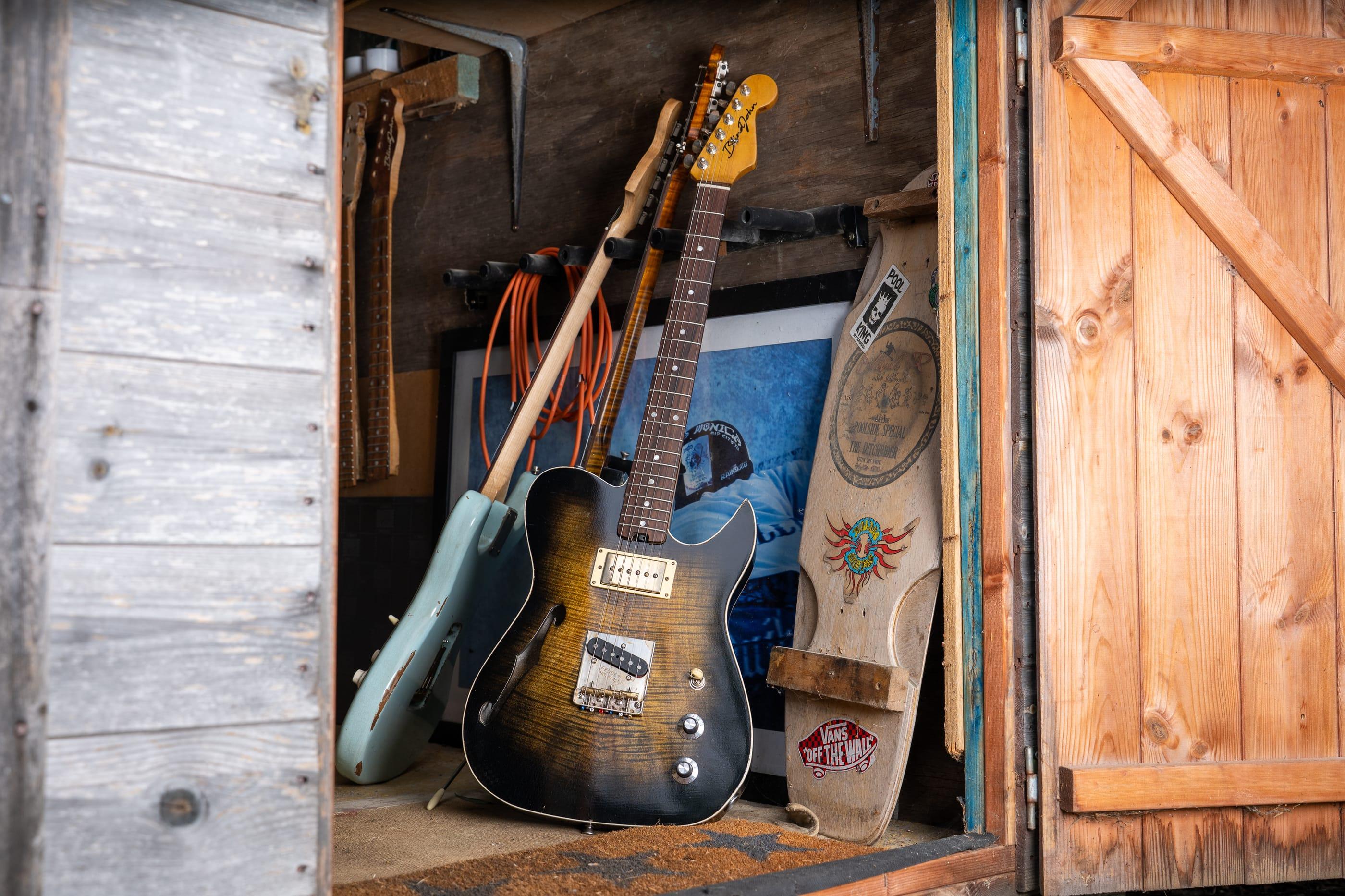
To use my guitars as an example, take the Thickline range. My Thickline is technically a hollow guitar. I have done a thinner, semi-hollow version. And obviously I've made Telecasters, which is what it's based on. If it was those three guitars with the same pickup, you would probably have with the hollow a little more rounded bottom end, because there is a large chamber for the sound to resonate in.
On a record. Rockabilly is a brilliant example.
A hollow body sound you'd know from a record? Rockabilly is a brilliant example. The two guitars that are synonymous with rockabilly are a hollow-bodied guitar like a Gretsch White Falcon and a solid-bodied single cut like a Telecaster. If you listen to Brian Setzer playing his big old hollow body Gretsch, it's very, very different to Luther Perkins on a Telecaster. There are amp and pickup differences, but if you plugged both those players into the same amp it would still be radically different. That tone is very different. It's bigger. It's less scooped out than the Telecaster is.
Feedback. Simply prone to feeding back a lot more.
That large chamber can create its own problems. If you put unpotted pickups in a hollow body guitar on a stage with a loud amp, you will have the most horrendous feedback issues that you can imagine.
Adding more gain through an already pushed amp can bring its own feedback problems. Add a hollow body guitar to that and those feedback problems can become exponentially worse, because they are simply prone to feeding back a lot more than a solid body guitar is. You only need to look at any singer-songwriter type that plays an acoustic on stage, live. Look closely and you'll probably find that in that acoustic guitar there is a cover on the sound hole.
Semi-hollow. Argue it until the cows come home.
What does semi-hollow mean? If you're looking at guitar specs, it can mean simply chambered. Even the old Smuggler Telecasters would technically be a semi-hollow, because parts of it are actually hollow. Semi-hollows are basically a hollow guitar, but they're built around a central beam. So everything from pickups to bridge to neck is down that central beam, and the outside is hollow.
| Hollow | A top, a back and air between them, the Thickline, 60mm deep on a heel block and a neck block; the DeVille, on a heel block and a box for the trem |
|---|---|
| Semi-hollow | Hollow either side of a solid centre block, the pickups and the bridge sit on the block: the 335's design |
| Chambered | A solid body with pockets routed out under the top, mostly to take weight out; the '68 Thinline is three separate chambers |
| Solid | Timber all the way through, the Gateway Drug line, in mahogany; Echo, the 107 and the Runaway on Tone Control |
When I was designing the Thickline, originally it was going to be semi-hollow, and I thought, why don't I just make it hollow? And I had some interesting results during the development of it, simply with doing different things to the insides. Say it was a central beam, the two halves left and right routed out, and then the top's on. That creates two chambers, one left, one right, and they're not linked. It's a very different sound to if you had, say, just a block where the bridge is, a block where the neck is and a block where the heel is.
With semi-hollows, I found that if I had a solid block in the middle with two chambers each side, and I linked those chambers, so I basically put cavities in that central beam, so if you filled up one side with water the water would go through to the other side, it was different again. Now, does that make it a hollow or a semi-hollow? That's probably something that you could argue, technically or semantically, from now until the cows come home. I wouldn't like to say exactly which, because I don't really have an answer.
The Thickline. As hollow as I can make them.
Some of my Thicklines are made differently, depending on what spec you've chosen. If you had, say, a floating bridge and a trapeze tail, that makes it easier to make almost entirely hollow. So for that sort I would use a thinner top, and it would be braced much like an acoustic. If they wanted, say, a Bigsby or a Jag-style trem, I couldn't use a top as thin, because it would just warp with the difference in pressures from the string pull and the pressure on the bridge. So I may use, say, a block where the trem sits. It's still hollow, but the top's not resonating in the same way. All these things do change the sound.
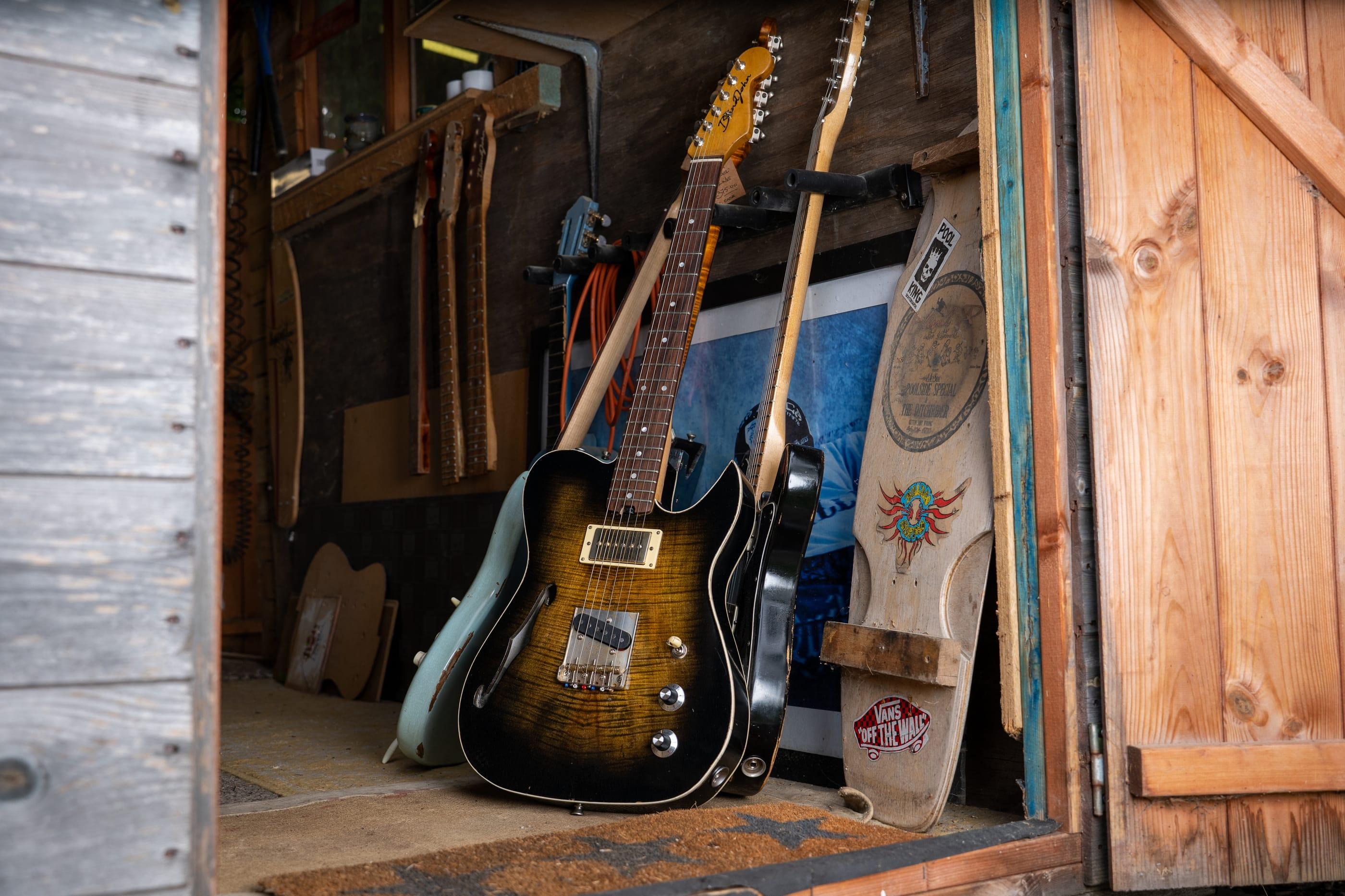
My Thicklines are hollow now, because most of them are as hollow as I can make them. Put simply, one of those will be radically different sonically to a solid body of the same size.
On the bench. What would it be like as a solid?
The DeVille was my hundredth guitar, and I wanted something particularly special for that. What would the bastard child of a Jaguar and a 335 look like, sound like? But moving forward, it occurred to me relatively recently: if you call the Thickline my signature model, well, that's a hollow body. The DeVille's hollow. So I thought, if I'm going to refine the DeVille shape, what would it be like as a solid? So that was the first choice.
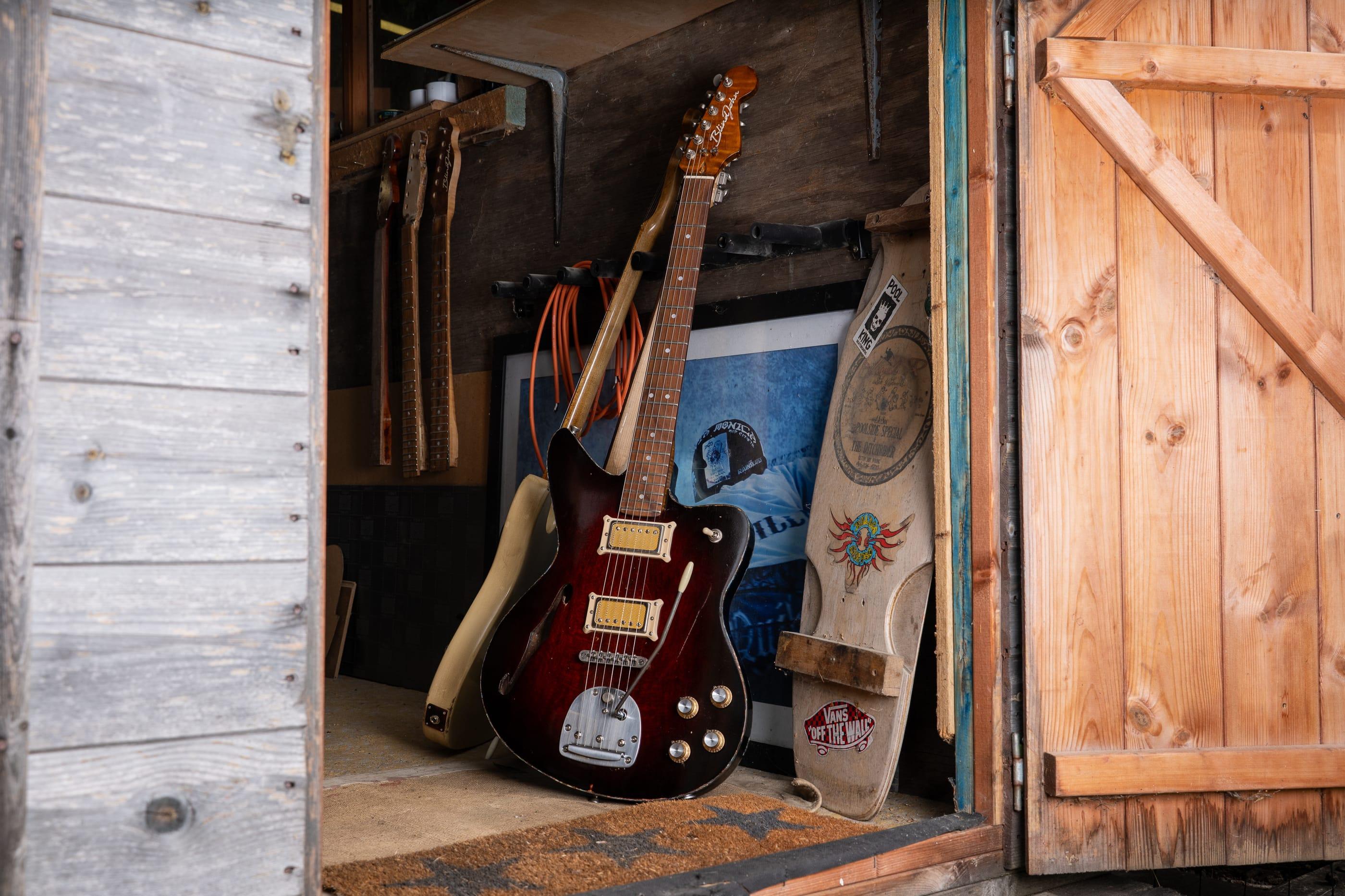
And I thought, well, one thing I don't really offer is a chambered Thinline version. So there's going to be a chambered Thinline version. An uber slim, 335-type thickness, semi-hollow would also be quite nice, and again different to the hollow bodies of the DeVille and the Thickline. Let's call it a Slimline Semi. Aesthetically and sonically it gives a different flavour, and it also adds a bit of diversity to what I'm making. Because this particular guitar will be one shape, various options.
I haven't got a clue what I'm going to call it yet. I don't like calling it the new DeVille, because while its roots are in the DeVille, it's not going to be a DeVille. I'm still trying to keep that retro vibe going. Of the first two, one will have a Bigsby and one will possibly have a trapeze tail. I'm literally squaring the billets up to start the first two bodies this afternoon.
Which is something I was thinking recently is not something I offer. But that's absolute bollocks, because it is something I offer, because I offer anything that a client wants. If they want a hollow body, I'm going to build them a hollow body.
| Recorded | 25 November 2026 |
|---|---|
| How | A cup of tea and a microphone, cut, not written |
| Who | John |